Showing posts with label Braxton Bragg. Show all posts

Friday, April 15, 2011

Lincoln: 75,000 to quell 'insurrection'

Lincoln
  • At Washington, President Lincoln, having achieved his wishes of the South firing defensively on Northern troops, today issues a public proclamation commanding all persons in arms against the Government to disperse within twenty days and calling for 75,000 state militia volunteers for three months to quell the insurrection in South Carolina. By comparison, in December 1860, there were barely 16,000 men in the Army, most positioned in the Western region of the United States. Instantly the Northern states respond with support. The New York legislature commits $3 million for the Union cause. Not so in the Border States and Upper South of Kentucky, Maryland, Missouri, North Carolina, and Virginia. Lincoln’s appeal becomes a public relations nightmare for the Administration in the Upper South. They respond with discontent, offense, and outrage when their governors receive a requisition for their state’s quota of volunteers. North Carolina and Kentucky refuse to respond to Lincoln’s appeal while up until today, Maryland has opposed Secession and was hoping for a peaceful reunion. Lincoln's call for troops to coerce the South forces them toward Secessionism./1861 
  • NC Gov Ellis
  • Governor of North Carolina, John W. Ellis, refuses to furnish his state’s quota of militia to the United States, saying, “I can be no party to this wicked violation of the laws of the country and to this war upon the liberties of a free people. You can get no troops from North Carolina.” North Carolina state militia accordingly seizes the unoccupied Fort Macon, N. C./1861
  • Isham G. Harris. Library of Congress descripti...Image via Wikipedia
    Gov. Isham Harris
  • Rejecting Lincoln's call for troops to subdue the ‘insurrection’ in the South, Tennessee Governor Isham Harris orders a second session of the state legislature to reconsider the question of calling a secession convention./1861 
  • Meanwhile in Charleston, South Carolina, the Confederate steamer with Major Anderson and his garrison on board cross the Charleston Bar and are transferred to the U.S.S. Baltic of Lincoln's Reinforcement Fleet headed by Navy agent Gustavus V. Fox. Then the Baltic, with the Fort Sumter garrison and the 200 reinforcements for Fort Sumter, embarks for New York. Private Daniel Hough, Battery E, First United States Artillery, is buried with all the honors of war by order of General Beauregard, C. S. A. He was killed on the 14th by the premature explosion of a cannon while saluting the Union flag on Fort Sumter at the evacuation./1861
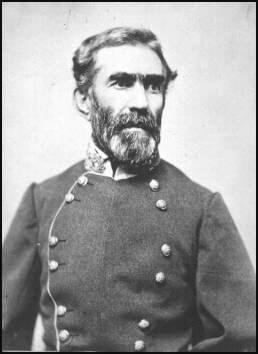
  • Confederate Brigadier General Braxton Bragg places US Lt. John Worden under arrest in Pensacola, Florida, making him the first prisoner-of-war in the War for Southern Independence./1861
  • In Montgomery, Alabama, Confederate Secretary of War Leroy P. Walker writes to Texas Governor Edward Clark, thanking him for his role in the seizure of a wagon train in Texas that had been attempting to take supplies to U.S. troops in New Mexico./1861
  • Confederate diplomat Ambrose Dudley Mann is the first to arrive in London today, hoping to encourage the British Government to support and recognize the Confederacy./1861

Tuesday, April 12, 2011

Firing on Fort Sumter

    Charlestonians at the Battery watch the battle
  • Floating Battery fires on Sumter
    [SIEGE OF FORT SUMTER] At 12:45 in the morning, the three Confederate messengers to Fort Sumter, Chestnut, Chisolm, and Lee, return to Major Robert Anderson at Beauregard’s request in a last ditch effort at a peaceful settlement. They ask Anderson for a time of probable evacuation. At 3:15am, he indicates noon April 15 as his target provided he receives no supplies or orders from Washington. 
The Confederates, knowing that an aid expedition is without doubt enroute, refuses to accept Major Anderson’s response. Five minutes later they give Anderson written notification of the commencement of an attack in one hour’s time. Leaving Fort Sumter at 3:30am, the aides proceed to Fort Johnson to order the commanding officer, Captain George S. James, to open fire at the prescribed time.  At 4:25 am, Capt. James at Fort Johnson sends up a signal flare to the other harbor batteries to open fire followed by the first shot. Lieutenant Henry Saxon Farley, a South Carolina Militia volunteer from Laurens, South Carolina, pulls the first lanyard on a ten inch seacoast mortar at Fort Johnson at 4:25am. Thus, Confederate troops defend their inherent right of Independence and begin a rotation of fire on a foreign, invading power at Fort Sumter. Firing will continue throughout the day and at intervals through the night. 

The citizens of Charleston are frenetic, with many watching the bombardment from rooftops throughout the city. The Achilles heel of Fort Sumter is wood on the inside of the fort. Since he is low on cartridge bags, Major Robert Anderson holds his fire until 7:00am, when US Captain Abner Doubleday fires the first shot from Sumter on the Iron Battery at Cummings Point. 

To protect his men, Anderson orders them to use only the 32 and 42 pound guns which are in the casemates instead of the heavier guns on the exposed top which could damage Southron defenses. In Fort Sumter, small fires are set by hot shot or bursting shells, but they are extinguished. Tonight, the Confederates slacken their fire, booming at twenty minute intervals; Anderson stops his fire.
The Baltic
  • Meanwhile at 3 o’clock in the morning and after three days of storms at sea, Captain Gustavus Fox on the Baltic, commanding Lincoln’s reinforcement fleet and the last straw as far as the Confederates are concerned, arrives at the rendezvous point ten miles outside Charleston Harbor. The Harriet Lane had arrived a few hours earlier, and at 6:00am the Pawnee arrives. There is no sign of the three tugboats, the Pocahontas, or the Powhatan. He considers sending one small boat to Fort Sumter, but decides the sea is too rough for launches. Waiting for the Powhatan, which Fox is unaware has mistakenly been ordered to Fort Pickens at Pensacola, Florida, Fox orders the transport steamer Baltic to steam into the Bar with its 200 men and arms of the 2nd US Artillery aboard that Lincoln lied about.  Fox discovers that Fort Sumter is already under fire and runs the Baltic aground at Rattlesnake Shoals. With either the tugs or the Powhatan he could enter the harbor and take part in the battle, but without either, he is stalled, and he watches the battle rage. His presence is visible by the Confederate command. The Baltic gets off Rattlesnake Shoals easily but is forced to move out to sea and anchor to watch the battle as Fox makes new plans to wait until tomorrow morning to move in to attempt a landing at Sumter./1861
Night-time reinforcement of Fort Pickens
  • At Fort Pickens on Santa Rosa Island at Pensacola Bay, Florida, US Lieutenant John L. Worden informs Confederate General Braxton Bragg of his arrival yesterday regarding the disposition of Fort Pickens. Bragg permits him to meet with US Captain Henry A. Adams aboard the Sabine, so long as he did not violate the "truce" that had been in effect since the last days of Buchanan’s Administration. Making no promises, Worden meets with Captain Adams around noon and presents his orders. Worden makes it to the Sabine just in time. Hours later, General Bragg receives a telegraph from the Confederate war department instructing him to "intercept" Worden.  
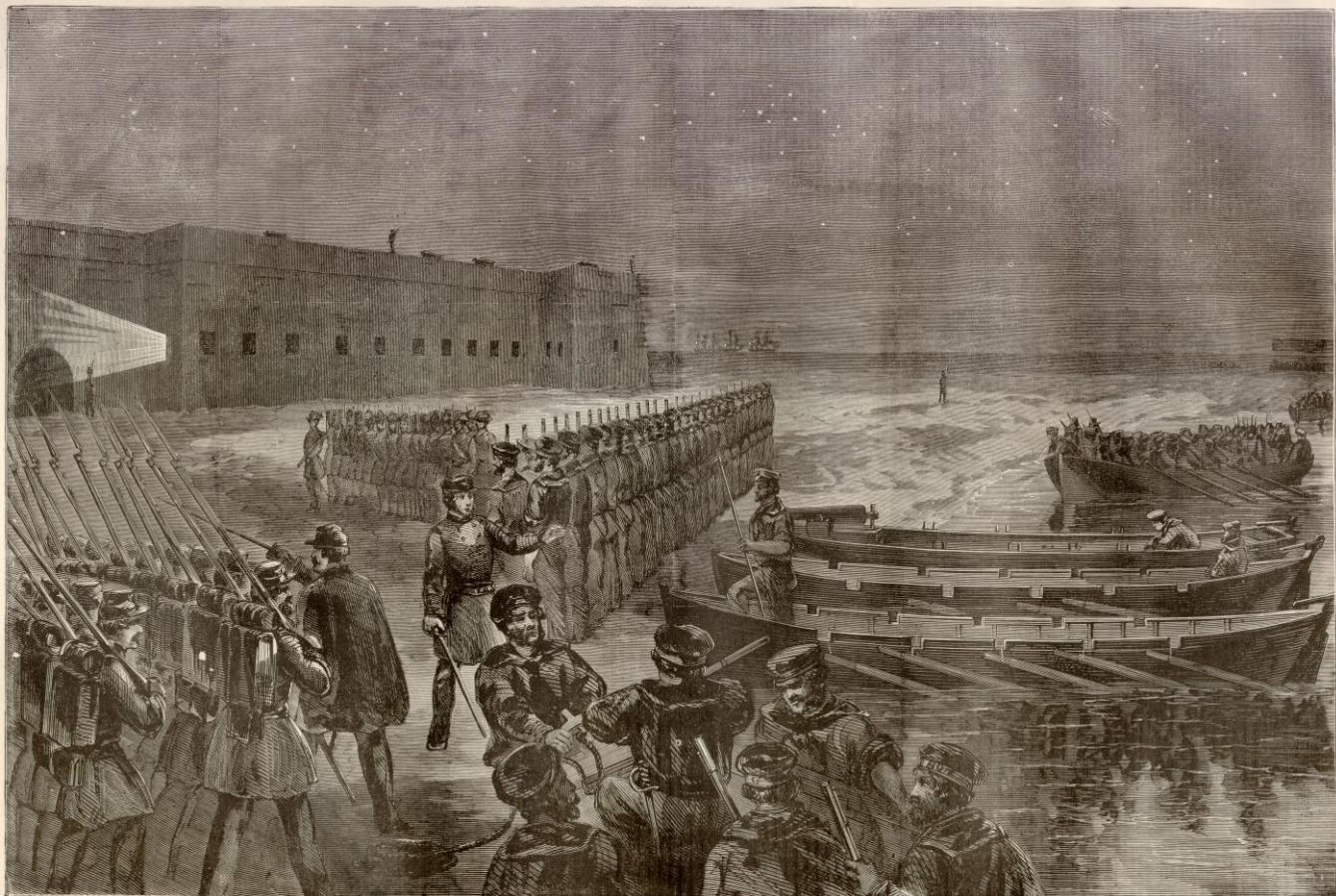
Tonight under cover of darkness, Adams lands Captain Vogdes, his troops, and a contingent of marines to reinforce the existing garrison at Fort Pickens. Adams later reports to Washington that "no opposition was made, nor do I believe the movement was known on shore until it was accomplished." Bragg telegraphs Secretary of War Leroy P. Walker in Montgomery that the order had arrived too late. Alarm guns had fired at Fort Pickens, he said, probably signaling the reinforcement of the fort. "It cannot be prevented," Bragg said. Bragg will confirm his fears in the morning: "Re-enforcements thrown into Fort Pickens last night by small boats from the outside. The movement could not even be seen from our side . . . ." Fort Pickens is successfully reinforced, preventing Confederate control of this important Gulf Coast defense, and providing Federal forces with an important base for operations in the Gulf./1861
    • Lincoln convenes a Cabinet meeting to hear from Talbot and Chew who have returned to Washington from their interview with Governor Francis Pickens and General Beauregard. Talbot returns the sealed dispatch to Major Anderson which he was not permitted to deliver. They have no idea that Beauregard is at that moment firing on Fort Sumter./1861
    Fort Sumter from Morris Island

    Sunday, April 10, 2011

    Davis' Cabinet votes to demand Sumter's surrender

    The original Confederate Cabinet. L-R: Judah P...Image via Wikipedia
    Davis & Original Cabinet
    • [SIEGE OF FORT SUMTER] The Pocahontas departs Brooklyn as the last ship in the expedition fleet to rendezvous at Charleston Harbor to relieve Fort Sumter. Meanwhile in Montgomery, President Jefferson Davis, interprets the expedition as an attempt to supply Fort Sumter "by force" and calls a Cabinet meeting. Davis insists that they should act in self-defense. Lincoln's dispatch of a relief expedition constitutes a "hostile" act, he said, and the reduction of Fort Sumter is, therefore, "a measure of defense rendered absolutely and immediately necessary." The fort is the legitimate possession of the state of South Carolina, and the state as well as the Confederate government has shown "unexampled" forbearance in trying to negotiate an equitable settlement with the United States for the removal of its forces. The sending of an expedition to maintain the fort is, he asserts, an act of "coercion" against South Carolina and the Confederacy. To permit the United States to further strengthen its position will be "as unwise as it would be to hesitate to strike down the arm of the assailant, who levels a deadly weapon at one's breast, until he has actually fired." All but one concur with Davis’ proposal to demand the surrender of Fort Sumter. Only Secretary of State, Robert Toombs of Georgia, vocally dissents. Toombs protests that an attack on Sumter would be "suicide, murder," and would stir a "hornet's nest" of hostility to the South. "It is unnecessary; it puts us in the wrong; it is fatal," Toombs pleads. After the discussion, the Cabinet votes to demand the surrender of Sumter. Therefore, Secretary of War Leroy P. Walker telegraphs Brigadier General P.G.T. Beauregard Provisional Army, CSA, in Charleston, to demand "at once" the evacuation of Fort Sumter. If Major Robert Anderson refuses, then reduce the fort. General Beauregard replies that he will demand surrender tomorrow at noon. All around Charleston Harbor, Confederate troops prepare for the expected battle. Tonight, the Floating Battery is emplaced at the west end of Sullivan's Island (Cove Inlet) to fire on Fort Sumter. It is commanded by its builder, Lieutenant J.R. Hamilton and manned by members of Company D of the Artillery Battalion./1861  
    • In an effort to build support, the Lincoln Administration leaks information about the Fox Expedition. Reports telegraphed from Washington the previous evening about the Sumter mission began to appear in northern newspapers. The New York Evening Post of April 10 welcomes the "revelation of the government's purpose to defend its property and maintain the laws." Referring to Lincoln's declared intent of peaceably provisioning "a destitute garrison," the Evening Post pontificates that "if the rebels fire at an unarmed supply ship," the responsibility will be "on their heads." When the ship arrives, the rebels will "elect between peace and war."/1861
    • In Washington, Secretary of State William Seward accuses former President James Buchanan of forming “vague and mysterious armistices” during the secession crisis, referring to the truce with Fort Pickens./1861
    • Brigadier General Braxton Bragg assumes command of the Confederate Department of Alabama and West Florida./1861
    • [SECOND SESSION] The Second Session of the Convention of the People of South Carolina adjourns today/1861

    Friday, April 8, 2011

    Relief expedition heightens tensions

    Inside Fort Sumter
    ·       In Washington this afternoon, the Confederate peace commissioners telegraph the Confederate government in Montgomery, Alabama, saying they have been formally notified by US Secretary of State William Seward that the United States has refused recognition, reception, or negotiation with them. The Confederate Secretary of War Leroy Pope Walker promptly alerts General Braxton Bragg, and repeats an order given earlier in the day to prevent the reinforcement of Fort Pickens at "every hazard." Meanwhile on Pennsylvania Avenue, with both the Fort Sumter and Fort Pickens expeditions in the process of departing New York, Lincoln writes the governor of neighboring Pennsylvania, saying that the necessity of being ready "increases. Look to it."/1861
    Anderson's quarters at Fort Sumter
    ·         Meanwhile at Fort Sumter, Major Anderson drafts a response to Lincoln's letter of April 4, expressing surprise at a relief expedition. He explains that Ward H. Lamon's visit had convinced him that Fox's plan would not be carried out, and he warns President Lincoln that an effort to relieve the fort under these circumstances "would produce most disastrous results throughout our country," adding that Fox's plan is impracticable and would result in a loss of life which would far outweigh the benefits of maintaining a position of no military value unless the surrounding Confederate positions were taken as well. Anderson concludes that his garrison would, nevertheless, "strive to do our duty, though I frankly say that my heart is not in the war which I see is to be thus commenced. That God will still avert it, and cause us to resort to pacific measures to maintain our rights, is my ardent prayer." But the imperial-minded Lincoln is not so inclined. Anderson's letter will never make it to Washington. It would be seized by South Carolina authorities following Confederate government orders to stop his mail./1861 
    USRC Harriet Lane
    ·      [SEIGE OF FORT SUMTER] As the tug Yankee and the Federal revenue cutter Harriet Lane departs Brooklyn, New York, Navy Yard for Fort Sumter in Charleston Harbor, South Carolina, US State Department clerk Robert S. Chew and Captain Theodore Talbot arrive in Charleston about 6 o'clock in the early evening and read a letter from President Lincoln to Governor Pickens of South Carolina stating that President Lincoln is sending food, and not soldiers to Fort Sumter, providing Pickens with a copy. This, however, is a blatant lie. Two hundred men are on board the fleet to reinforce Fort Sumter. Governor Pickens calls in General Beauregard and reads him the same message. Beauregard refuses Talbot's request to return to his post at Sumter or to communicate with Major Anderson, saying he is under orders to permit no communication with Fort Sumter, unless it conveyed an order for its evacuation. 

    With the meeting over, Chew and Talbot are escorted to the railroad depot and leave Charleston at 11 p.m. Then Pickens and Beauregard forward Lincoln’s threatening letter to President Davis in Montgomery that "provisions would be sent to Sumter peaceably, otherwise by force." Accordingly, Davis orders Confederate forces under Beauregard to ready its forces around Charleston Harbor for military action and that "under no circumstances" was he to allow provisions to be sent to Fort Sumter."/1861

    Friday, March 11, 2011

    Scott: "Surrender Sumter", Lincoln: "Reinforce Pickens"


    • In Washington, President Jefferson Davis' Peace Commissioners, Crawford, Forsyth, and Roman, request a meeting with United States Secretary of State-designate, the Hon. Mr. Seward, but Mr. Seward refuses an interview/1861 
    • Braxton Bragg arrives at Pensacola to assume Confederate command of military forces in Florida./1861
    • The Confederate Congress unanimously adopts a Permanent Constitution for the Confederacy today/1861 
    • US General Scott informs President Lincoln that the relief of Fort Sumter was unfeasible and that the Army cannot be responsible for reinforcing Fort Sumter immediately. Scott contends it would take up to eight months to authorize and prepare an expedition large enough to relieve the fort. A month ago, perhaps, it would have been a different matter, but “since then a surrender under assault or from starvation has been merely a question of time,” adding that the situation at Charleston, South Carolina, is becoming a real crisis which the Army alone cannot handle effectively. He recommends that Major Robert Anderson be instructed to evacuate the fort. Instead of listening to reason, Lincoln orders General Scott to "exercise all possible vigilance for the maintenance of all the places within the military departments of the United States" and specifically directs Scott to reinforce Fort Pickens at Pensacola Bay, Florida, the more accessible of the two forts./1861

    Monday, March 7, 2011

    Southern Peace Commissioners frustrated

    Brig. Gen. Braxton Bragg, CSA
    • President Davis in Montgomery assigns Brigadier General Braxton Bragg, Mexican War hero from North Carolina, to command Confederate troops at Pensacola, Florida, with instructions to give special attention to Fort Pickens./1861
    • Lincoln appoints Salmon P. Chase his Treasury Secretary./1861
    • In Washington, the Confederate Peace Commissioners, Martin J. Crawford, John Forsyth, and A.B. Roman, sent by President Davis to negotiate peace and avert any possibility of a war between the States, continue to push for an appointment with someone in the new Lincoln Administration. They contact influential leaders in Washington who have expressed some support the Southern position and those who do not support the seceded states but are in favor of a peaceful negotiation, but it appears that the new Administration in Washington is bent entirely toward armed conflict./1861

    Wednesday, January 12, 2011

    Southerners decide to withdraw from Congress

    • In Washington, US Congressmen and Senators from the South meet in Georgia Senator Albert Gallatin Brown's room to decide whether to wait until March 4 (Lincoln’s Inauguration Day) before leaving their seats and thus stop hostile legislation against the South or to go home now. They vote to withdraw immediately, and the Mississippi Representatives withdraw from the Congress. These Southern Congressmen and Senators were motivated primarily, according to Senator Thomas Bragg of North Carolina, by a sense of honor. They also discuss the formation of a provisional national government and agree that Senator Robert Toombs of Georgia will be president and Jefferson Davis will be general-in-chief of the Army. On the US Senate floor, Senator William Seward (R-NY) wisely wondered, “I do not know what the Union would be worth if saved by the use of the sword.”/1861
    • In Pensacola, Florida, the state military has seized all the military installations around Pensacola Bay including Fort Barrancas, its barracks, the naval yard on the mainland, and Fort McRee at the entrance to the Bay. The only installation left is Fort Pickens where Federal forces numbering 81 men under US Lieutenant A.J. Slemmer moved two days ago. Soon the Republic of Florida military will demand the surrender of Fort Pickens. This will create a second dangerous hotspot for the Federal government along with Fort Sumter./1861