Showing posts with label Raphael Semmes. Show all posts

Wednesday, July 6, 2011

Diplomacy and the Confederate Navy

Raphael SemmesImage via Wikipedia
Cdr. Raphael Semmes, CSN
Cienfuegos, CubaImage via Wikipedia
Cienfuegos, Cuba
  • At Cienfuegos, Cuba, the commander of the CSS Sumter, Raphael Semmes, has in less than a week captured seven United States shipping vessels. He attempts to deposit the prizes in the port of Cienfuegos by casually telling the Spanish colonial governor that he assumes Cuba would treat Confederate ships with “the same friendly reception as to cruisers of the enemy.” Because such action could appear as diplomatic recognition of the Confederate government, the governor refuses the vessels, and Semmes is forced to release his prizes./1861
  • President Jefferson Davis writes Lincoln that if the captured crewmen of the CSS Savannah are executed as pirates as has been determined, that Davis will order a like number of Northern prisoners executed. /1861 

Saturday, July 2, 2011

Feds invade the Valley; Suspension of habeas corpus extended to NYC

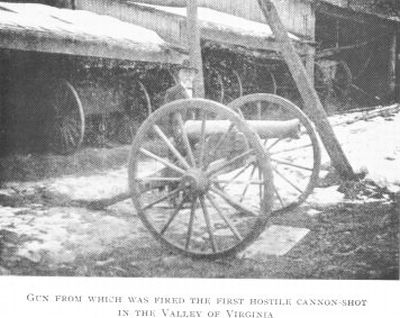
The first cannon used to defend the Valley
  • Raphael Semmes in the CSS Sumter burns the Golden Rocket at Sea in the Gulf of Mexico. /1861 
  • Federal troops under Gen. Robert Patterson cross the Potomac River at Williamsport, Maryland, and head toward Harper’s Ferry and the Shenandoah Valley where they intend to curtail the movement of Confederate forces toward Manassas Junction, Virginia. In the process, they push Confederate troops under Thomas J. Jackson off the field at the Battle of Hoke’s Run in West Virginia. Also, Colonel Thomas J. Jackson fights an engagement at Hainesville near Martinsburg, West Virginia. At this battle the first hostile cannon shot is fired in the Defense of the Valley of Virginia./1861 
  • In Washington, Abraham Lincoln, in a letter to General of the Army Winfield Scott, expands the suspension of the writ of habeas corpus to areas between Washington and New York City. Previously he has already suspended it between Baltimore and Washington and in parts of Missouri. The Supreme Court has already ruled Lincoln’s suspension unconstitutional, but Lincoln ignores the ruling, extending his tyranny up the seaboard, taking away the rights of citizens to speak against the government or have some recourse against the military. The rights of habeas corpus are enshrined in the United States Constitution, and are so central to a civilized society that to suspend them strips the rights of every citizen. Habeas corpus (Latin for “bring forth the body") provides for a citizen's right to a fair trial, the right to face one's accuser, and force the accuser to prove the guilt of the accused. Habeas corpus protects against unlawful arrests and prevents unlawful imprisonment. It is a common feature of Western civilization. That is, until Lincoln arrived in town from Springfield, Illinois. In other business, General John Fremont meets with President Lincoln in Washington to discuss Fremont’s appointment to command US forces in Missouri where there have been crazy politics and violent unrest. Lincoln wants Missouri stabilized and forced by military might to stay in the Union. Never has a US President been so brazen./1861
  • At Wheeling, in western “Federal” Virginia, a new legislature convenes with the backing of the Lincoln Administration./1861

Saturday, June 18, 2011

Johnston evacuates Harper's Ferry

CS General Joseph E. Johnston wearing the 3 st...Image via Wikipedia
J.E. Johnston

Monday, April 4, 2011

Virginia rejects secession referendum; Lincoln pressures Fox

Virginia State Capitol
  • In long-running Virginia State Convention considering secession, the delegates meeting in Richmond vote 89-45 against holding a statewide referendum on secession from the Union./1861
    • Meanwhile in Washington, President Lincoln meets at the White House with Virginia unionist John B. Baldwin, a member of the Virginia convention considering secession. Secretary of State Seward had arranged the meeting some time ago when most sane people had hoped Lincoln would evacuate Fort Sumter for the sake of peace in exchange for assurances that the Richmond convention would adjourn, keeping Virginia in the Union. But by the time of today’s meeting, Lincoln had ordered expeditions for both Forts Sumter and Pickens. The President explains to Baldwin that the crisis has escalated, but that the Virginia convention still needed to adjourn. In light of developments, Baldwin rejects the President’s request, instead demanding the Federal government withdraw from both forts. Lincoln then abruptly ends the meeting.

    United States Navy officer Gustavus FoxImage via Wikipedia
    Gustavus V. Fox
    • Later, Lincoln calls for Navy Captain Gustavus Fox, mastermind of the Fox Plan, and informs him that he will indeed “let the expedition go,” but Fox is worried whether it can make it to Charleston in time to save Major Anderson. The President, pushing his agenda, tells Fox it is his duty to his country to attempt the mission. Then Lincoln responds to an April 1 communique from Major Robert Anderson at Fort Sumter in which Anderson says he has about a week of rations left. Still under the impression that he will be evacuated shortly, Anderson has not put his garrison on short rations. Lincoln informs him of the upcoming relief of Fort Sumter, saying “the expedition will go forward” and should be expected “the 11th or 12th, a full week after his rations are scheduled to be depleted.” Lincoln orders Anderson to maintain the status quo if possible, but Lincoln gives him freedom to decide how to respond in the event of an attack by Confederate forces./1861
    • Raphael Semmes, lately resigned from the U.S. Navy, returns from buying munitions in the North and begins his work in the Confederate lighthouse service/1861 

    Tuesday, February 15, 2011

    Montgomery: Friendly but determined negotiation

    Alabama Capitol staircase where Confederate Congress met
    • The new Confederate Provisional Congress meeting in Montgomery passes a resolution that the new President-elect Davis should appoint a commission of three persons to be “sent to the government of the United States of America, for the purpose of negotiating friendly relations between that government and the Confederate States of America, and for the settlement of all questions of disagreement between the two governments upon principles of right, justice, equity, and good faith." In the event that peaceful negotiations are not possible, the Congress also resolves to take Fort Sumter at Charleston, South Carolina, and Fort Pickens in Pensacola, Florida, by force if necessary. Delegates from recently seceded Texas arrive in Montgomery to take seats in the Confederate Congress./1861 

    • Assistant adjutant-general of the U.S. army, L. Thomas, writes today (received March 1) to the newly appointed army commander in Texas, Colonel C.A. Waite of the U.S. First Infantry, that General-in-Chief Winfield Scott, orders that, in the event of the secession of Texas, Colonel Waite should, "without unnecessary delay, put in march for Fort Leavenworth [Kansas], the entire military force of your department,” sending any supplies they cannot carry with them by water to New York. Scott’s purpose is twofold: to keep federal property out of the hands of a seceded Texas and to punish Texas for their action by leaving the state’s frontier open to Indian attack. By the time the order would arrive (March 1), the Texas state militia and the Commissioners of the Committee of Public Safety of Texas would have received the surrender of all federal property in the state and all US Army personnel would leave by way of the coast./1861

    • In Washington, the Peace Conference drags on interminably, discussing and debating every detail of several proposed compromises to the secession crisis, with no real hope for a durable solution, entirely because President-elect Lincoln has indicated his absolute opposition to any compromise with the Southern States./1861

    • Raphael Semmes resigns from the United States Navy to defend his state of Alabama/1861 

    • On his trip to be inaugurated the sixteenth President of the United States, President-elect Abraham Lincoln, from the Manongahela House balcony in Pittsburgh, Pennsylvania, in the longest address of his journey, strangely remarks that “there is no crisis, excepting such a one as may be gotten up at anytime by turbulent men, aided by designing politicians.” After a carriage ride through nearly impenetrable crowds to the train station, Lincoln continues to Cleveland, Ohio, by late afternoon in a rain and snow storm. While having his mid-day dinner with the president of the railroad at Sourbeck’s Hotel in Canton, Ohio, a company of Canton Zouaves stand guard while a band plays national airs, and a gun salute shatters a hotel window during meal, sprinkling glass on Mrs. Lincoln. Again he meets large crowds, though the Democrat-leaning Cleveland Plain Dealer reporter wonders if the warm receptions are thinly veiled requests for political appointments. Welcomed by tens of thousands with military escort, Lincoln says, “"I think that there is no occasion for any excitement. The crisis, as it is called, is altogether an artificial crisis." Later Lincoln’s son, Robert, causes some excitement when he misplaces the President-elect’s satchel of the Inaugural Addresses./1861