Showing posts with label Illinois. Show all posts

Friday, August 12, 2011

McCulloch: "Let Missouri choose her destiny"

photo of Benjamin McCulluch (1811-1862)Image via Wikipedia
Gen. Ben McCulloch
  • After Federal forces under Gen. Nathaniel Lyon have chased the pro-secession Missouri State Guard, its commander, Gen. Sterling Price, and its duly elected Governor Claiborne Fox Jackson, out of the state capital at Jefferson City and nearly out of the state. At last, at Wilson’s Creek near Springfield, reinforced by Confederate General Benjamin McCulloch’s Western Army composed of Arkansans and Cherokees, they had made a stand, and now Lyon is dead and the Federals in retreat. Gen. Ben McCulloch, today gives Missouri citizens an ultimatum: it is time to take sides. Unlike Lyon and the Federals, McCulloch promises protection to Union sympathizers, but “Missouri must be allowed to choose her own destiny.”/1861
  • At Washington, by proclamation, President Lincoln appoints the "last Thursday in September next, as a day of humiliation, prayer and fasting for all the people of the nation." In a recess appointment, Lincoln reappoints William S. Wood, who had charge of the special train that brought Lincoln to Washington for his inauguration, as commissioner of public buildings, as the Senate failed to act on his appointment before adjourning. /1861
  • US Navy Commander J. Rodgers arrives with gunboats USS Tyler, Lexington, and Conestoga, at Cairo, Illinois, to protect the junction of the Ohio and Mississippi Rivers and to guard against Confederate movements./1861

Tuesday, June 7, 2011

Douglas buried; Apalachicola, Fla, blockaded

  • In Chicago, Illinois, the "Little Giant," Stephen F. Douglas, is buried. Across the North, government offices remain closed in his honor. In Washington, President Lincoln orders black bunting hung on the White House and receives no visitors today./1861
  • The New Orleans Zouaves arrive in Richmond, Virginia, creating quite a scene and stir in their distinctive uniforms. The Zouave uniform is inspired by the Zouaoua tribal dress of North Africa and was copied out of respect for their fighting spirit by the Spanish and French armies that fought them in Algeria and Morocco. Those same French and Spaniards when they came to the Americas brought that uniform with them to their new found home of Louisiana. Many of the Louisiana Militia units wore the Zouave uniforms. These Louisiana men were hard fighters, hard drinkers and passionate in their zeal for the Confederate States of America. The Zouaves of Louisiana could be compared with ease to the Special Forces of today; they moved fast, hit hard, and took no prisoners./1861 

Friday, June 3, 2011

Confederates surprised at Philippi, Virginia

  • CONFEDERATE MEMORIAL DAY in Tennessee, Kentucky, and Louisiana. (Jefferson Davis birthday, 1808).
  • The Democrats and the Union lose a strong supporter when Stephen F. Douglas dies unexpectedly at age 48 in Chicago, Illinois,, complications following rheumatic fever or typhoid. In Washington, President Lincoln mourns the “Little Giant” of the famous Lincoln-Douglas Debates who had defeated the President in the 1858 US Senate race in Illinois but who lost to Lincoln in the 1860 Presidential election./1861
  • Battle of Philippi, western Virginia
  • Union troops under Colonel R.F. Kelley march out of the mountains through the night in driving rain and this morning surprise Confederate forces under Colonel G.A. Porterfield, at Philippi, western Virginia, and the raw Confederates retreat rapidly under fire. The Confederate troops flee the field so quickly that the Northerners call their triumph the “Philippi Races.” Only a skirmish with about 3000 Union soldiers routing roughly 800 Confederate soldiers, no one is killed in this first land engagement of the war. It helps propel the Union commander - General George B. McClellan to fame. The Confederate defeat also has a bearing on western Virginia’s secession from the Old Dominion as the absence of Confederate troops in the area encourages pro-Union Virginians in the west to declare their support for the North./1861 
  • In Washington, Lincoln, continuing under the paranoia of an imminent invasion of the District of Columbia by the demon Southerners, writes commander of the Army Winfield Scott, "I have accounts from different sources, tending to some expectation of an attack being made upon our forces across the Potomac to-morrow morning. I think it prudent to say this to you, although it is highly probable you are better informed than I am[.]"/1861
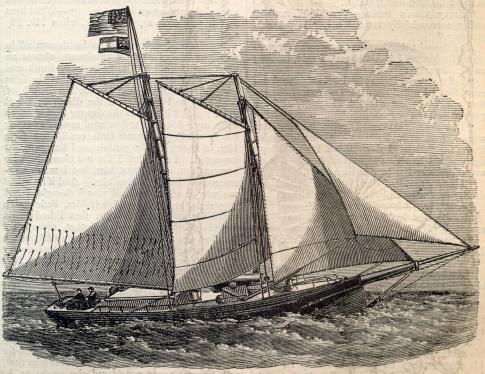
  • CSS Savannah flying both US and CS flags
  • The privateer Savannah, which left port in Charleston, South Carolina, only yesterday, overhauls the brig Joseph and sends her into Georgetown, SC. In the afternoon the brig U.S.S. Perry attacks and captures the privateer Savannah. Her cruise is ended and her crew is arrested and taken to New York./1861 
  • Confederate Secretary of War Stephen F. Mallory instructs Lieutenant John Mercer Brooke to develop an ironclad design for construction in the South./1861
  • Against its will but forced by Governor Henry M. Rector, the Arkansas Secession Convention finally adjourns, but political turmoil will continue in Confederate Arkansas. General William J. Hardee will be assigned to command Confederate forces in Arkansas, but many soldiers will not want to join the regular army and risk being moved away from their home state. A lack of organization and cohesive command will plague Arkansas for the remainder of 1861./1861

Wednesday, June 1, 2011

Recruits flood armies; Skirmishes at Arlington, Fairfax, VA

  • Confederate Mail Service begins as Confederate and US postal services end official cooperation , though mail will continue across the lines throughout the war in various ways./1861 
  • In northern Virginia, a small body of raw Confederate recruits routs and disperses 85 Regulars of the Second United States Cavalry at Chantilly, Virginia. The 2nd US Cavalry had been sent from Arlington to reconnoiter and engages the Confederate troops at Arlington Mills and Fairfax Court House. Virginia Militia Captain John Q. Marr, an officer of promise, of the Warrenton (VA) Rifles is killed. He is one of the first Southern officers to die for independence. The Yankees suffer several dead and wounded, and leave seven dead horses and many arms in the street./1861 
  • In a decision aimed at both United States and Confederate States vessels, the British government declares British territorial waters and ports off-limit to belligerents  vessels carrying spoils of war./1861
  • In Virginia, Southern boys are gathering into training camps and issued obsolete Mexican War flintlocks as frantic orders are placed in Europe for the new cap lock muskets./1861
  • At Cairo, Illinois, where the Mississippi and Ohio Rivers join, gun emplacements are being tested including a 32-lb. mortar./1861
  • The Sons of Erin, citizens of Ireland living in Donaldsonville, Louisiana, volunteer for Confederate service./1861

Tuesday, May 10, 2011

St. Louis Massacre

  • The border state of Missouri has assets that both sides want to appropriate for themselves. While his commanding officer at the St. Louis Federal Arsenal, US General William S. Harney is out of town, US Captain Nathaniel Lyon with 6,000 combined militia and regulars including Francis Blair Jr.’s disliked German-immigrant Home Guard, marches 4 ½ miles from the arsenal to attack the 669 Missouri Volunteer Militia under command of General Daniel M. Frost at Camp Jackson. In the fight, Lyon seizes the Camp Jackson barracks. 
Frost peacefully surrenders his 669 men and 1,200 valuable Model 1855 Springfield Rifles, but the Missouri Militiamen refuse to take an oath of allegiance to the Federal government. Capt. Lyon then places them all under arrest and in his arrogance decides to humiliate the surrendered state militiamen and march them through the downtown St. Louis streets toward the federal arsenal before paroling them and ordering them to disperse. To add to the insult, Lyon placed the captured militiamen between two lines of the armed German Home Guards. Bad idea. 

When the local citizenry sees this display, their anger boils over in mass riots, with civilians hurling rocks, paving stones, and insults at Lyon’s men, especially the Germans. Then a drunkard stumbles into the path of the marching soldiers, and fires a pistol into their ranks, fatally wounding Captain Constantin Blandowski. Capt. Lyon’s men, especially the German Home Guard respond by firing first over the heads of the crowd, then into them, killing some 28 people, some of whom were women and children, and wounding over 100 more.  

Two uninvolved non-combatants who just happened to be in town that day were nearly killed in the shooting: William T. Sherman, walking with his son and brother-in-law, and Colonel Ulysses S. Grant of the 21st Illinois Volunteer Infantry. Thus, Federals secure control of St. Louis, Missouri, with the rifle and bayonet./1861
  • President Jefferson Davis in Montgomery, Alabama, orders the purchase of warships and munitions for the Confederate government. Secretary of the Navy Stephen F. Mallory suggests the addition of ironclads to the small Confederate Navy, for advantage over the U.S. Navy’s much larger and more diverse fleet./1861
  • President Lincoln directs the commander of U.S. forces on the Florida coast to suspend the writ of habeas corpus, "if he shall find it necessary."/1861
  • In Wheeling, western Virginia, the first company of US Virginia Infantry is mustered into Federal service./1861

Monday, May 9, 2011

Covert Confederate munitions arrive at St. Louis

St. Louis, Missouri in 1859
  • At St. Louis, Missouri, Missouri Volunteer Militia officers meet a shipment of crates on board the steamer J.C. Swon at the St. Louis riverfront marked Tamoroa marble, and transport them to Camp Jackson, six miles inland. In mid-April, Governor Claiborne Jackson had sent two militia officers, Colton Green and Basil Duke, to President Jefferson Davis in Montgomery, Alabama, requesting artillery and mortars for an attack on the St. Louis Arsenal. The crates of Tamoroa marble shipped to the Missouri Volunteer Militia are in fact two 12 pound Howitzers, two 32 pound siege guns, five hundred muskets, and ammunition from assets seized from the Federal arsenal at Baton Rouge./1861
  • At Newport, Rhode Island, the USS Constitution and the steamer Baltic (which had been the main ship in the Fox Expedition to Fort Sumter), prepare to set up the U.S. Naval Academy which has been moved from Annapolis, Maryland, because of uncertainties there./1861 
  • While many on both sides have expected a short war and have called for volunteers for mere months, President Jefferson Davis today wisely and quietly signs a measure setting all future enlistments “for the duration of the war” rather than a set period of time. In other work today in Montgomery, Alabama, Davis dispatches James D. Bullock to Great Britain to purchase arms and vessels from the British for the Confederate cause./1861
  • The Federal blockade of Virginia precipitates and exchange of gunfire between the Federal vessel Yankee and Confederate batteries on shore at Gloucester Point, Virginia./1861
  • Texas State Militia captures United States troops at San Lucas Spring, Texas./1861

Monday, April 25, 2011

Illinois militia steal from St. Louis arsenal

  • Much to President Lincoln’s relief, New York's 7th Regiment arrives in Washington, having gone around Baltimore by boat. Lincoln considers the monstrous anti-Constitutional act of sending US troops to prevent the Maryland Legislature from meeting and potentially arming the people of that state against the United States, but he concludes it would not be justifiable./1861
  • Governor John Letcher proclaims Virginia a part of the Southern Confederacy./1861
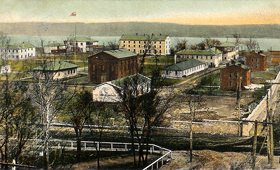
  • U.S. Arsenal, St. Louis, Missouri
    Missouri is on the verge of secession, and St. Louis has one of the largest federal arsenals west of the Appalachian mountains. No wonder President Davis has been urging Missiouri governor Claiborne Jackson to seize it. Others also had their eye on that St. Louis arsenal. In a daring nighttime theft to damage Missouri secessionists, Illinois militiamen led by Captain James H. Stokes of Chicago, secretly steam on the Mississippi River from Alton, Illinois, to St. Louis, Missouri, and by theft remove 10,000 muskets from the Federal Arsenal with the help of federal troops there. In his return to Alton, Illinois, the next morning, he supplies munitions to the Illinois state militia./1861
  • Brig. Gen. Edwin Vose Sumner is appointed commander of the Department of California, replacing Col. Albert Sidney Johnston, who resigns to become a full General commanding Confederate Department No. 2, which encompasses most of the western Confederacy./1861
  • Battle of Indianola, Texas. Major C. C. (Caleb Chase) Sibley surrenders 420 United States Infantry troops to Confederate forces capture at Saluria, Texas./1861

Friday, April 22, 2011

Lincoln: "What is to become of the revenue?"

Governor Hicks, though himself a slaveholder, ...Image via Wikipedia
Gov. T.H. Hicks
  • Maryland Governor Thomas Holliday Hicks calls a session of the Maryland legislature to consider secession. Unrest in Baltimore continues to threaten the security of the District of Columbia as troops go through Maryland on their way to Washington. President Jefferson Davis, communicating with Virginia Governor John Letcher, indicates his hope that he will be able to “sustain Baltimore if possible.”/1861
  • Pres. Lincoln
    President Lincoln meets at the White House with a distinguished delegation of the Young Men’s Christian Association (YMCA) of Baltimore led by Rev. Dr. Fuller of the Baptist Church of Baltimore. According to the Baltimore Sun, Fuller endeavors to impress on the President his unique responsibility and privilege to foment fratricidal war or a lasting peace. Lincoln asks, “But what am I to do?” Fuller urges him to recognize that the Southern States have formed a government of their own and they will not come back. Without referring to the constitutionality of secession, Fuller suggests he can simply recognize the Confederacy and both North and South can be relieved of their great anxieties and move forward in pursuit of peace. Lincoln responds, “And what is to become of the revenue? I will have no government, no resources,” reflecting the underlying reason for Lincoln’s great vision for preserving the Union – the fact that the Southern States provided a majority of Federal government revenue. As the conversation turns to the offense of troops coming through Baltimore to “subdue the South,” Lincoln insists that he has called the troops only for defense of the Capitol, not for invasion of the Southern States. “And,” Lincoln says, “I must have the troops, and mathematically, the necessity exists that they should come through Maryland. They can’t crawl under the earth, and they can’t fly over it, and mathematically they must come across it. Why sir, those Carolinians are now crossing Virginia to come here and hang me, and what can I do?” Despite Fuller’s pleading for a peaceful course, Lincoln remarked that there “would be no Washington in that, no Jackson in that, no spunk in that!” Dr. Fuller hoped that Lincoln would not allow spunk to override patriotism, but Lincoln said there was no way that he or Congress would recognize the Southern Confederacy. After the YMCA delegation departs the White House, they “agreed on the hopelessness of their errand and the sad prospect that any good thing from such a source, and the exclamation was actually made, ‘God have mercy on us, when the Government is placed in the hands of a man like this!”/1861
  • Following the destruction of the Norfolk Navy Yard, the Washington Navy Yard has become indispensible. But there are personnel problems. Today Commandant Capt. Franklin Buchanan resigns to serve with the South. The Chief of Navy Ordnance, George Magruder, flees to Canada for the duration of the war, and the entire yard has dwindled to 150 men./1861
  • The Clarksburg (present-day West Virginia) Convention calls for an anti-secessionist convention to be held in May, 1861./1861
  • Illinois state militia garrisons Cairo, Illinois, on the Mississippi River./1861
  • Arkansas Governor Henry M. Rector refuses to send troops to support Lincoln’s quota to suppress secession, stating, “the people of this commonwealth are freemen, not slaves, and will defend to the extremity their honor, lives, against Northern mendacity and usurpation.”/1861
  • North Carolina state militia assumes control of the Federal arsenal at Fayetteville, North Carolina./1861

Sunday, March 27, 2011

Lincoln's friends: Withdraw to avoid War

Stephen A. Hurlbut. Library of Congress descri...Image via Wikipedia
Gen. S.A. Hurlburt
  • Now back in Washington, President Lincoln’s personal friend from Illinois, Stephen A. Hurlbut, reports to President Lincoln. Hurlburt has found in South Carolina and Charleston "no attachment to the Union . . . . positively nothing to appeal to." A separate Southern nationality is an "established fact." 
Equally conclusive is Hurlbut's appraisal of the Confederacy's plans to take Forts Sumter and Pickens. He has "no doubt" that Southern forces would repulse any type of relief effort, even a ship containing only provisions and no troops. Even if the government abandons Sumter, the crisis would continue as the South would "demand" Fort Pickens and the remaining federal forts in Florida. Thus, any attempt to maintain and enforce federal authority within the limits of the Confederacy would mean "War, in fact, War in which the seceding States will be united and the others disunited." 

Lincoln trying to figure out this Union thing
Hurlbut's travel partner, another trusted personal Illinois friend of the President, Colonel Ward H. Lamon, agrees with Hurlbut's assessment. South Carolina is swept with a madness that is hurrying the masses into open rebellion. According to Lamon's Carolina sources, war can be avoided only if the federal government acquiesces to peaceable secession and refuses to reinforce its Southern forts. Any attempt to reinforce Sumter would bring "the tocsin of war."/1861
  • Meanwhile in Charleston, Confederate Brigadier General P. Gustave T. Beauregard advises President Jefferson Davis in Montgomery that the evacuation of Fort Sumter "ought to be decided upon in a few days" by the Lincoln Administration. He recommends that "this state of uncertainty ought not to last longer than is necessary to have all our preparations made to compel ... a surrender, should the United States Government not be willing to withdraw ... peaceably."/1861

Wednesday, March 23, 2011

Lincoln sends two friends to Charleston

Ward Hill Lamon. Library of Congress descripti...Image via Wikipedia
Ward H. Lamon

Stephen A. Hurlbut. Library of Congress descri...Image via Wikipedia
Stephen Hurlburt
  • Besides the visit of Gustavus V. Fox to Charleston and Fort Sumter, President Lincoln has also dispatched two personal friends from Illinois to assess the situation in Charleston, South Carolina. Stephen A. Hurlbut, has family and friends in Charleston, and Ward H. Lamon arrives on official US government business. Hurlbut travels as a private citizen and stays with his sister for two days before returning to Washington. Lamon arrives to examine some post office matters. Lamon’s official status, his imposing physical size, and talkativeness draws more attention than Hurlbut. In two days, Lamon has a formal interview with South Carolina Governor Pickens and is permitted to visit Major Anderson at Fort Sumter. Lamon gives the impression to both Governor Pickens and Anderson that Fort Sumter will be soon evacuated./1861
  • U. S. troops abandon Fort Chadbourne, Texas./1861

Sunday, February 27, 2011

Peace Conference ends, Lincoln unmoved

Peace Conference, Washington
  • In Washington at the Willard Hotel, the Peace Conference ends by offering six proposed Constitutional amendments, but none of them have any chance of acceptance. The Senate rejects the Peace Conference proposals, and the House does not even consider them. With a pre-inauguration climate of a President who talks peace publicly and prepares for war privately, it seems politics is turning toward conflict. The US Congress strikes down a proposal for a constitutional convention, votes down Constitutional amendments to interfere with slavery, and votes down again the Crittenden Compromise./1861

  • Meanwhile, Washington, D. C. Mayor James G. Berret extends an official welcome to President-elect Lincoln, who resides at the Willard Hotel. Mayor Berret expresses the hope that Lincoln will "restore peace and harmony to our now distracted country." Lincoln acknowledges the "ill feeling that has existed and still exists between the people of the section from whence I came and the people here." He declares, "I have not now any purpose to withhold from you any of the benefits of the constitution . . . that I would not feel myself constrained to withhold from my own neighbors." Later, Lincoln talks with Sen. Stephen Douglas (Illinois) who stays late to make impassioned plea for the conciliation of the South. At 9 PM, a group of border statesmen, including former Sec. of Treasury James Guthrie of Kentucky and Alexander W. Doniphan of Missouri, calls on Lincoln to talk compromise. Despite these pleas and many others, Lincoln is unmoved in his absolute recalcitrance when it comes to compromise./1861
  • P. Gustave T. Beauregard becomes Brigadier General of the Confederate States Army./1861
  • South Carolina Governor Pickens requests from President Davis that the Confederacy assume command of the situation at Fort Sumter to preserve “honor and safety.”/1861
  • President Davis writes President-elect Lincoln, commending “Martin J. Crawford, John Forsyth, and A. B. Roman, [as] appointed special commissioners of the Confederate States to the United States” with “an earnest desire to unite and bind together our respective countries by friendly ties,” asking Lincoln to receive and treat with them in formal negotiations for peace and friendship. Lincoln, disinterested in peace, will never acknowledge them./1861

Wednesday, February 16, 2011

Davis arrives in Montgomery, Lincoln kisses a girl

Jefferson Davis on a white horse
  • President-elect Jefferson Davis arrives at 10:00pm by train amid shouts from a large crowd in Montgomery, Alabama, from his plantation Brierfield near Vicksburg, Mississippi, to accept the call of the Southern people and be inaugurated to the Presidency of the Confederate States of America. Along the route, Davis made twenty-five speeches, returning thanks for the complimentary greetings to the crowds assembled at the various depots where he was received with military escorts and salutes. A Congressional committee and Montgomery authorities meet President Davis about eight miles from Montgomery, and formally received him. Two fine military companies from Columbus, Georgia, had joined the escort at Opelika, Alabama. Davis thanks the large crowd at the depot for the hospitality of the citizens of Alabama. In a short speech, he briefly reviews the present position of the South and says the time for compromises has passed. “We are now determined to maintain our position and make all who oppose us smell Southern powder and feel the Southern steel,” Davis says./1861 

  • At 6am in San Antonio, Texas, the Commissioners of the Committee on Public Safety, representing the seceded Republic of Texas, Thomas J. Devine, S. A. Maverick, and P. N. Luckett, demand the surrender of the US Arsenal at San Antonio even as “during the past night,” according to the US Arsenal authorities, “the town of San Antonio had been invaded by armed bodies of Texans [(over 1,000 Texas militia)], who had seized the property of the United States.” US Brevet Major-General D.E. Twiggs, after reading the demand for surrender, says he “gave up everything,” but nothing official happens./1861
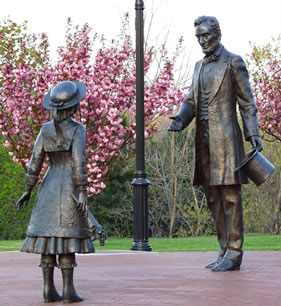
Lincoln and Grace Bedell, Westfield, NY
  • Even the anti-Republican Cleveland Plain Dealer “must confess to being most favorably impressed with both” Mr. and Mrs. Lincoln. The whistle-stop train trip from their home in Springfield, Illinois, to his inauguration in Washington has begun paying political dividends. Leaving Cleveland at 9:00 a.m., the presidential party has a packed travel day to Buffalo, New York. At Westfield, New York, Lincoln meets now twelve-year-old Grace Bedell, who had written to Presidential candidate Lincoln suggesting he grow a beard. Back during the campaign on October 15, 1860, the 11 year old Bedell had written Lincoln to suggest a way for him to get elected: “I have got 4 brothers and part of them will vote for you any way and if you let your whiskers grow I will try and get the rest of them to vote for you. You would look a great deal better for your face is so thin. All the ladies like whiskers and they would tease their husbands to vote for you and then you would be President.” 
Lincoln replied four days later: “As to the whiskers, having never worn any, do you not think people would call it a piece of silly affectation if I were to begin it now?” The silly affectation must have caught on for him, for today at Westfield, New York, Lincoln was sporting a beard. 
The Philadelphia Enquirer reports what happened next and quotes Lincoln, “Some three months ago, I received a letter from a young lady here; it was a very pretty letter, and she advised me to let my whiskers grow, as it would improve my personal appearance; acting partly upon her suggestion, I have done so; and now, if she is here, I would like to see her; . . . A small boy, mounted on a post, with his mouth and eyes both wide open, cried out, ``there she is, Mr. LINCOLN,'' pointing to a beautiful girl, with black eyes, who was blushing all over her fair face.” The President left the car, and the crowd making way for him, he reached her, and gave her several hearty kisses, and amid the yells of delight from the excited crowd, he bade her good-bye.  
In Buffalo, former President Millard Fillmore greets his arrival at 4:30pm. The crowd of 10,000 is so dense and aggressive that the guest party is separated and Maj. David Hunter dislocates his shoulder while escorting Lincoln./1861