Showing posts with label Fort Sumter. Show all posts

Saturday, August 13, 2011

Confederate Navy contracts British shipbuilders


Cmdr. James D. Bulloch, CSN
  • Confederate Naval Commander and Secret Service Agent James Dunwoody Bulloch writes from Liverpool in the United Kingdom to Confederate Secretary of the Navy Stephen Mallory: “After careful examination of the shipping lists of England, and inspecting many vessels, I failed to find a single wooden steamer fit for war purposes, except one paddle steamer, too large and costly for our coast. Wood as a material for ships has almost entirely gone out of use in the British merchant service, and their iron ships, though fast, well built, and staunch enough for voyages of traffic, are too thin in the plates and light in the deck frames and stanchions to carry guns of much weight. I therefore made arrangements to contract with two eminent builders for a gun vessel each . . .” Bulloch has signed his first contract with Fawcett & Preston Engineers in Liverpool and WC Miller and Son Ship Builders to build the CSS Florida, which would be finished by years’ end. He has signed the second contract in July 1861 with John Laird Sons and Company who has a shipyard near Liverpool to build the Enrica, the alias for the famous Confederate raider, the CSS Alabama. To be commanded by Admiral Raphael Semmes beginning one year from today, the CSS Alabama would range the globe for two years destroying Union merchant ships – 55 in all valued at US$4.5 million, plus ten others bonded at an additional US$562,000. In addition, Semmes would capture over 2,000 prisoners, not one harmed but deposited at the nearest port, all this without losing a single man./1861
  • In Washington, Gen. Robert Anderson, the Kentucky native who had commanded the US forces inside Fort Sumter back in April, dines with the President and is informed of his appointment on completion of his convalescence to a command in Kentucky, violating the state’s neutrality. Gen. George B. McClellan also spends most of the evening at White House. /1861
  • The USS Powhatan, commanded by Lieutenant David D. Porter, recaptures the schooner Abby Bradford off the mouth of the Mississippi River./1861

Monday, July 4, 2011

27th Congress special session convenes

    Hon. Abraham Lincoln, President of the United ...Image by The Library of Congress via Flickr
  • It’s the big day in Washington, and not just because it is the first Independence Day since the war began. A special called session of the 27th Congress convenes, summoned by President Lincoln to handle his war measures, and fund his war to destroy the republic and preserve the Union. In a speech meant more for the press than the Congress, Lincoln addresses a joint session claiming the North has done everything in its power to maintain peace. He says his Administration has attempted to solve the problems without resorting to war, problems which he maintains the South has caused by seceding. The similarities between Lincoln’s list of tyrannical acts and claims and the offenses of King George III described in the Declaration of Independence are striking. Lincoln blames his entire fiasco at Fort Sumter on the South and insists that the United States must maintain its “territorial integrity against its own domestic foes.” If the man had any integrity himself, he would have understood that once the states seceded that they were no longer domestic foes. Again Lincoln belabors his position concerning the indivisibility of the Union, using that heretofore unknown national policy to justify his unconstitutional Presidential declaration of war on the Confederate States. Then the President concludes his address with a now-typical Lincoln request for 40,000 additional troops from the Northern states./1861
  • Although no longer an official holiday in the South, this day still has an air of gratefulness to God and celebration of Freedom; and in honor of the day, President Jefferson Davis presents a Confederate flag to the Maryland Regiment in the Confederate Army. /1861 
  • At Harper’s Ferry, Virginia, Confederate and Federal troops briefly skirmish as they pour into the lower Shenandoah Valley./1861

Sunday, May 15, 2011

Wheeling Convention closes; Lincoln: "Protect the gold"

  • At the First Wheeling Convention in Wheeling, western Virginia, Unionist Virginians who are so much against Virginia’s secession that they wish to secede from their own state, agree on the third and last day of debate that the Convention should wait until after Virginia’s referendum on secession on May 23 before deciding how to move forward. The convention passes resolutions calling for the election of delegates to their own intrastate secession convention on June 4 and the convening of a Second Convention at Wheeling, Virginia, on June 11./1861
  • One month after surrendering Fort Sumter, Robert Anderson is promoted to Brigadier General in the US Artillery./1861
USS Bainbridge off Cuba 1862
  • Today the USS Bainbridge is ordered to the Atlantic coast of Panama to guard this major transshipment point for cargo from the American west coast--including the gold mines of California. Lincoln is concerned that California gold shipments would be very attractive to Southern privateers, since the Confederate government desperately needs gold to buy munitions abroad./1861

Sunday, May 1, 2011

Jackson removes arms from Harpers Ferry

Haprpers Ferry in 1865, and the north terminus...Image via Wikipedia
Harper's Ferry, Virginia
  • In Montgomery, Alabama, Congressman Walter Brooke of Mississippi introduces a bill in Confederate Congress to move the capital city to Richmond, Virginia./1861
  • President Lincoln writes Gustavus V. Fox, to encourage him as he was deeply disappointed he could not resupply Fort Sumter in time to keep Major Anderson in the fort. Lincoln’s encouragement shows from his own hand his shrewd plan to force war on the South, “You and I both anticipated that the cause of the country would be advanced by making the attempt . . . even if it should fail."/1861
  • Soldiers of the 6th Massachusetts Regiment who were killed in the Baltimore riots on April 19 are honored at ceremonies in Boston./1861
  • Governor Letcher of Virginia calls for volunteers for the Confederate army while in Nebraska Territory, a call for volunteers to support the Union goes out./1861
  • In one of his first orders as commander of the State Militia, Major General Robert E. Lee orders Major Thomas J. Jackson to the arsenal at Harpers Ferry, Virginia, to remove all weapons and equipment for gun and cannon manufacturing as well as any other munitions and move them South to keep them from the danger of being stolen by Federal forces from the north or Unionist sympathizers from Virginia./1861
  • Claiborne Fox JacksonImage via Wikipedia
    Missouri Gov. Jackson
  • Missouri Governor Claiborne Fox Jackson, part of the Unionist Douglas faction of the Democratic party, but privately a secessionist, calls out the Missouri Volunteer Militia for maneuvers about 4.5 miles northwest of the St. Louis Federal Arsenal at a place called Lindell's Grove. The militia, under command of General David M. Frost, names their training ground Camp Jackson after their governor. Governor Jackson wants them to prepare to assault and take the Federal Arsenal, the largest depository of munitions west of the Appalachian Mountains./1861
  • Federal forces seize two Confederate ships in the waters of the Atlantic, and the U.S. Navy blockades the mouth of the James River./1861
  • Union army officer James R. Greene, assisting in the evacuation of US troops from Texas, reports to fellow officer C. C. Sibley that, while carrying out his responsibility, he had heard a rumor that his command was to be made prisoners of war. Not believing it, he still checked it out and found it to be true./1861

Friday, April 15, 2011

Lincoln: 75,000 to quell 'insurrection'

Lincoln
  • At Washington, President Lincoln, having achieved his wishes of the South firing defensively on Northern troops, today issues a public proclamation commanding all persons in arms against the Government to disperse within twenty days and calling for 75,000 state militia volunteers for three months to quell the insurrection in South Carolina. By comparison, in December 1860, there were barely 16,000 men in the Army, most positioned in the Western region of the United States. Instantly the Northern states respond with support. The New York legislature commits $3 million for the Union cause. Not so in the Border States and Upper South of Kentucky, Maryland, Missouri, North Carolina, and Virginia. Lincoln’s appeal becomes a public relations nightmare for the Administration in the Upper South. They respond with discontent, offense, and outrage when their governors receive a requisition for their state’s quota of volunteers. North Carolina and Kentucky refuse to respond to Lincoln’s appeal while up until today, Maryland has opposed Secession and was hoping for a peaceful reunion. Lincoln's call for troops to coerce the South forces them toward Secessionism./1861 
  • NC Gov Ellis
  • Governor of North Carolina, John W. Ellis, refuses to furnish his state’s quota of militia to the United States, saying, “I can be no party to this wicked violation of the laws of the country and to this war upon the liberties of a free people. You can get no troops from North Carolina.” North Carolina state militia accordingly seizes the unoccupied Fort Macon, N. C./1861
  • Isham G. Harris. Library of Congress descripti...Image via Wikipedia
    Gov. Isham Harris
  • Rejecting Lincoln's call for troops to subdue the ‘insurrection’ in the South, Tennessee Governor Isham Harris orders a second session of the state legislature to reconsider the question of calling a secession convention./1861 
  • Meanwhile in Charleston, South Carolina, the Confederate steamer with Major Anderson and his garrison on board cross the Charleston Bar and are transferred to the U.S.S. Baltic of Lincoln's Reinforcement Fleet headed by Navy agent Gustavus V. Fox. Then the Baltic, with the Fort Sumter garrison and the 200 reinforcements for Fort Sumter, embarks for New York. Private Daniel Hough, Battery E, First United States Artillery, is buried with all the honors of war by order of General Beauregard, C. S. A. He was killed on the 14th by the premature explosion of a cannon while saluting the Union flag on Fort Sumter at the evacuation./1861
  • Confederate Brigadier General Braxton Bragg places US Lt. John Worden under arrest in Pensacola, Florida, making him the first prisoner-of-war in the War for Southern Independence./1861
  • In Montgomery, Alabama, Confederate Secretary of War Leroy P. Walker writes to Texas Governor Edward Clark, thanking him for his role in the seizure of a wagon train in Texas that had been attempting to take supplies to U.S. troops in New Mexico./1861
  • Confederate diplomat Ambrose Dudley Mann is the first to arrive in London today, hoping to encourage the British Government to support and recognize the Confederacy./1861

Thursday, April 14, 2011

Confederates occupy Fort Sumter


    Confederates occupy Fort Sumter, April 14, 1861
  • [SIEGE OF FORT SUMTER] Major Robert Anderson formally surrenders Fort Sumter. At 11:00am a Confederate steamer arrives at Fort Sumter to move the Union troops to the Federal fleet off the Charleston Bar. According to the generous terms of surrender, Anderson salutes the United States flag with 100 barbette guns on the ramparts as it is lowered. 
Accident during Sumter surrender ceremony
A stiff breeze is blowing into the muzzles of the guns and one of the smoldering cartridges blows back into a pile of cartridges in the broken masonry near a gun. The pile explodes, sending pieces of broken masonry off like shell fragments. US Private Daniel Hough is instantly killed; another is fatally injured, dying soon afterward at a Charleston hospital. Four others are injured. One of the injured is treated in a hospital and sent north after Anderson leaves. The others are treated and sent home with their comrades. At 4:00pm, South Carolina State Militia take Fort Sumter after the evacuation. 

The Union troops are placed on the relief transport steamer Baltic with Navy agent Gustavus V. Fox and his 200 reinforcements. They will wait there all night so they could see in the morning to cross the Charleston Bar./1861
Charleston Battery, April 1861
  • Parades, celebrations and a general holiday fills the air in Charleston, South Carolina today as the defeated Union garrison of Fort Sumter leaves. Across the state of South Carolina, thousands of men volunteer to defend their state from the Northern aggressor. On this Sunday, Charleston churches hold special services of thanksgiving. South Carolina Governor Pickens says, “We have met them and we have conquered."/1861
  • After receiving official notice of the surrender of Fort Sumter, Lincoln calls an emergency Cabinet meeting. As if by design, Lincoln emerges to call for 75,000 volunteers to quash the rebellion and for a session of Congress to meet beginning July 4./1861

Wednesday, April 13, 2011

Fort Sumter surrenders


SumterImage via Wikipedia
Fort Sumter on fire, April 13, 1861
    CHARLESTON, SC - APRIL 12:  Confederate re-ena...Image by Getty Images via @daylife
    Reenactors @ Ft. Moultrie
  • [SIEGE OF FORT SUMTER] This morning Major Anderson resumes firing on the Confederate forces. A Confederate hot shot sets fire to the officers' quarters and spreads to the barracks. After a small amount of powder is obtained, Anderson closes the magazines to prevent an explosion. Seeing Fort Sumter on fire, Southron batteries double their fire. Flames leap above the parapets. Smoke in the casemates hinders the garrison from operating the guns. Firing is cut almost to nothing, but they continue as much as possible. With each shot, the Southrons mount their parapets and cheer their enemy's gallantry. Finally Fort Sumter ceases fire. About 1:30pm, a Confederate shot brings down the flag. 
Explosion inside Fort Sumter
Then an explosion occurs on Fort Sumter. Soon afterwards, former US Senator, now Confederate Colonel Louis T. Wigfall with a flag of truce approaches Fort Sumter, crawls through an embrasure, and asks to speak with Major Anderson. The Cummings Point batteries have ceased firing, but Fort Moultrie continues.

Charleston watches the battle
While Anderson is being notified of a visitor, Colonel Louis T. Wigfall suggests that they raise a white flag to stop Fort Moultrie's firing, but the men reply that only Major Anderson could do so. Then Wigfall waves his truce flag, but Fort Moultrie continues to fire. Major Anderson soon arrives and Wigfall offers him any terms of surrender he wants. Anderson, out of food and with an insufficient number of men to properly garrison the fort, concludes that further conflict is useless and that his men had done their best despite great difficulty.

Major Anderson accepts the terms offered by General Beauregard on the 11th. By 2:30pm, the Southern forces see a white flag flying from the ramparts. At 7:30pm the terms are accepted on both sides and the battle ends. The officers' quarters and barracks were destroyed in the bombardment and fire, but the walls are hardly damaged. Thirty-four hours and 3000 shot and 40,000 shells had been spent in the battle, with no lives lost on either side and only a few wounded. Major Anderson remains in charge of the fort until tomorrow noon./1861
  • [SIEGE OF FORT SUMTER] For Gustavus Fox and his Sumter Relief Expedition watching the battle outside Charleston Harbor, thick fog and heavy swells delay their attempts to load boats with provisions for Sumter. Determined to carry in at least some supplies, the Pawnee captures an ice schooner and makes it available to Fox for an attempt that evening. Captain Gustavus V. Fox hopes to send in the captured ice schooner tonight, but alas, he sees the white flag over Fort Sumter. About the time Fort Sumter stops firing, the Pocahontas arrives about 2:00pm, but the essentials, the Powhatan and the tugs, never arrive. The Powhatan had been removed by the Lincoln Administration in all its sagacity in a secret and wholly impractical maneuver authorized by Lincoln to aid the Federals at Fort Pickens, Florida. The other ships of the Relief Expedition have been scattered all over the seaboard. Bad weather has stopped the tugs. The Freeborn's owners had prevented her from sailing because of the gale; the Uncle Ben was driven into Wilmington, North Carolina, by the gale, and the authorities there seized it. The Yankee overshot Charleston because of the storm which drove her to the entrance of Savannah, and she did not get back to Charleston until the Baltic had returned north with Anderson's garrison. Fox expects he would have "certainly been knocked to pieces" should he try to reinforce Fort Sumter, but he does not get a chance. Anderson surrenders the fort first./1861 
  • The people of Richmond, Virginia, receive news of the surrender of Sumter, and in response, great delight is exhibited and 100 guns are fired. As farmers rush to town to hear the news, bonfires are kindled, rockets sent up, tumultuous excitement reigns. The bells of Richmond toll all night, cannons boom, shouts of joy are heard, and "Dixie's Land" is heard on each of the seven hills of Richmond. People denounce the Virginia Convention's tardiness in achieving Secession; attempts are made to fly the Stars and Bars from the Capitol Dome, and shouts of hurrah for the hero Beauregard, the Southern Confederacy, and "Down with the Old Flag!" Tomorrow is the Sabbath and all demonstrations will be quieted in respect for the day, but talk of it continues except at worship/1861
  • Meanwhile in Washington, President Lincoln, hearing unconfirmed reports of an attack on Fort Sumter, says, “I shall hold myself at liberty to repossess, if I can, places like Fort Sumter if taken from Federal control.”/1861
  • In West Texas, troops of the 8th US Infantry under Capt. Edward D. Blake abandon Fort Davis, Texas, (named for US Secretary of War Jefferson Davis and located 175 miles southeast of El Paso), as part of a complete abandonment of West Texas forts. They head to report to San Antonio. Meanwhile, Larkin Smith to writes to C. C. Sibley from Green Lake, Texas, that he has come to arrange for the embarkation of Union troops onto a ship bound for New York Harbor./1861
  • Col. Harvey Brown, Second United States Artillery, assumes command of the U.S. Department of Florida./1861

Tuesday, April 12, 2011

Firing on Fort Sumter

    Charlestonians at the Battery watch the battle
  • Floating Battery fires on Sumter
    [SIEGE OF FORT SUMTER] At 12:45 in the morning, the three Confederate messengers to Fort Sumter, Chestnut, Chisolm, and Lee, return to Major Robert Anderson at Beauregard’s request in a last ditch effort at a peaceful settlement. They ask Anderson for a time of probable evacuation. At 3:15am, he indicates noon April 15 as his target provided he receives no supplies or orders from Washington. 
The Confederates, knowing that an aid expedition is without doubt enroute, refuses to accept Major Anderson’s response. Five minutes later they give Anderson written notification of the commencement of an attack in one hour’s time. Leaving Fort Sumter at 3:30am, the aides proceed to Fort Johnson to order the commanding officer, Captain George S. James, to open fire at the prescribed time.  At 4:25 am, Capt. James at Fort Johnson sends up a signal flare to the other harbor batteries to open fire followed by the first shot. Lieutenant Henry Saxon Farley, a South Carolina Militia volunteer from Laurens, South Carolina, pulls the first lanyard on a ten inch seacoast mortar at Fort Johnson at 4:25am. Thus, Confederate troops defend their inherent right of Independence and begin a rotation of fire on a foreign, invading power at Fort Sumter. Firing will continue throughout the day and at intervals through the night. 

The citizens of Charleston are frenetic, with many watching the bombardment from rooftops throughout the city. The Achilles heel of Fort Sumter is wood on the inside of the fort. Since he is low on cartridge bags, Major Robert Anderson holds his fire until 7:00am, when US Captain Abner Doubleday fires the first shot from Sumter on the Iron Battery at Cummings Point. 

To protect his men, Anderson orders them to use only the 32 and 42 pound guns which are in the casemates instead of the heavier guns on the exposed top which could damage Southron defenses. In Fort Sumter, small fires are set by hot shot or bursting shells, but they are extinguished. Tonight, the Confederates slacken their fire, booming at twenty minute intervals; Anderson stops his fire.
The Baltic
  • Meanwhile at 3 o’clock in the morning and after three days of storms at sea, Captain Gustavus Fox on the Baltic, commanding Lincoln’s reinforcement fleet and the last straw as far as the Confederates are concerned, arrives at the rendezvous point ten miles outside Charleston Harbor. The Harriet Lane had arrived a few hours earlier, and at 6:00am the Pawnee arrives. There is no sign of the three tugboats, the Pocahontas, or the Powhatan. He considers sending one small boat to Fort Sumter, but decides the sea is too rough for launches. Waiting for the Powhatan, which Fox is unaware has mistakenly been ordered to Fort Pickens at Pensacola, Florida, Fox orders the transport steamer Baltic to steam into the Bar with its 200 men and arms of the 2nd US Artillery aboard that Lincoln lied about.  Fox discovers that Fort Sumter is already under fire and runs the Baltic aground at Rattlesnake Shoals. With either the tugs or the Powhatan he could enter the harbor and take part in the battle, but without either, he is stalled, and he watches the battle rage. His presence is visible by the Confederate command. The Baltic gets off Rattlesnake Shoals easily but is forced to move out to sea and anchor to watch the battle as Fox makes new plans to wait until tomorrow morning to move in to attempt a landing at Sumter./1861
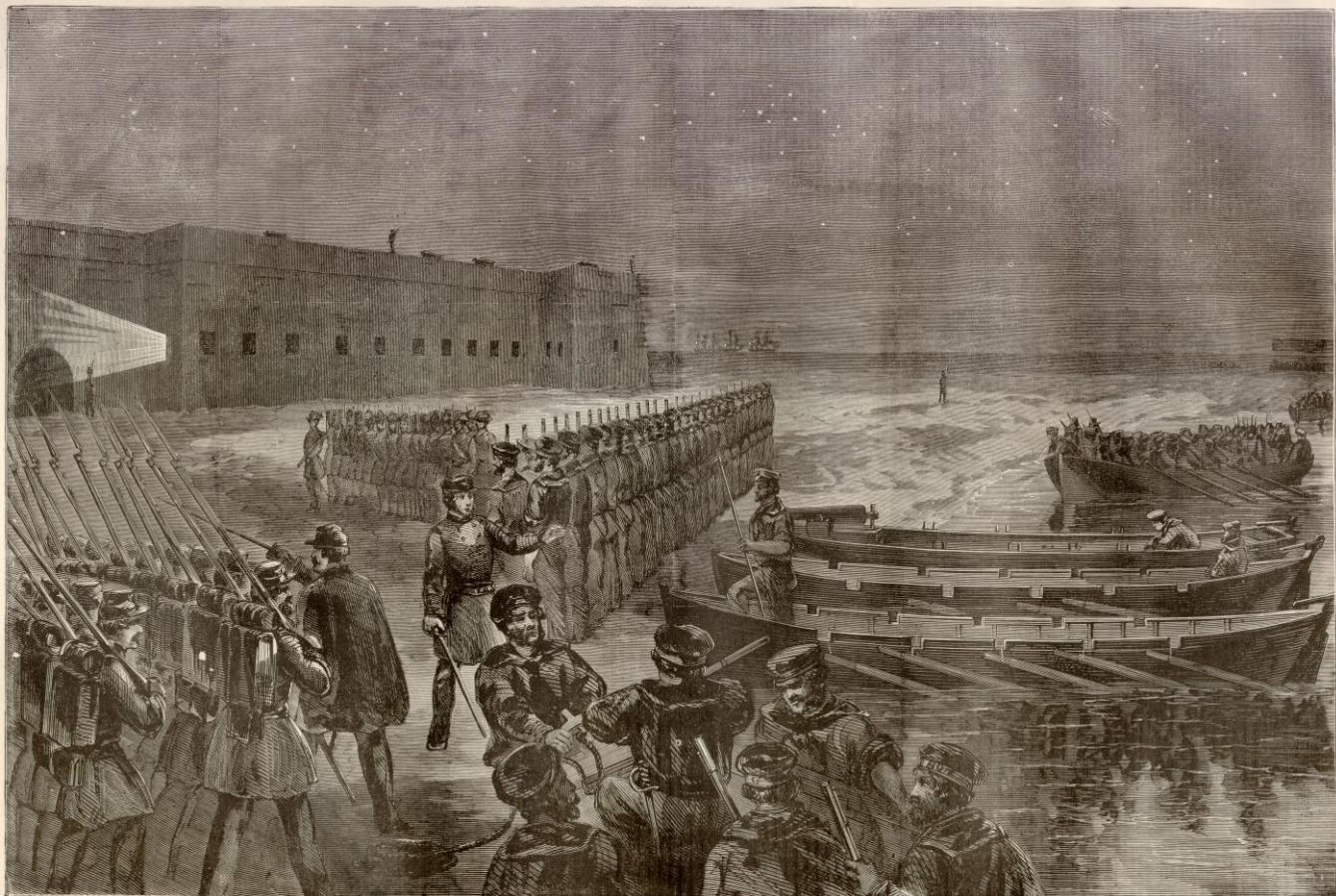
Night-time reinforcement of Fort Pickens
  • At Fort Pickens on Santa Rosa Island at Pensacola Bay, Florida, US Lieutenant John L. Worden informs Confederate General Braxton Bragg of his arrival yesterday regarding the disposition of Fort Pickens. Bragg permits him to meet with US Captain Henry A. Adams aboard the Sabine, so long as he did not violate the "truce" that had been in effect since the last days of Buchanan’s Administration. Making no promises, Worden meets with Captain Adams around noon and presents his orders. Worden makes it to the Sabine just in time. Hours later, General Bragg receives a telegraph from the Confederate war department instructing him to "intercept" Worden.  
Tonight under cover of darkness, Adams lands Captain Vogdes, his troops, and a contingent of marines to reinforce the existing garrison at Fort Pickens. Adams later reports to Washington that "no opposition was made, nor do I believe the movement was known on shore until it was accomplished." Bragg telegraphs Secretary of War Leroy P. Walker in Montgomery that the order had arrived too late. Alarm guns had fired at Fort Pickens, he said, probably signaling the reinforcement of the fort. "It cannot be prevented," Bragg said. Bragg will confirm his fears in the morning: "Re-enforcements thrown into Fort Pickens last night by small boats from the outside. The movement could not even be seen from our side . . . ." Fort Pickens is successfully reinforced, preventing Confederate control of this important Gulf Coast defense, and providing Federal forces with an important base for operations in the Gulf./1861
    • Lincoln convenes a Cabinet meeting to hear from Talbot and Chew who have returned to Washington from their interview with Governor Francis Pickens and General Beauregard. Talbot returns the sealed dispatch to Major Anderson which he was not permitted to deliver. They have no idea that Beauregard is at that moment firing on Fort Sumter./1861
    Fort Sumter from Morris Island

    Monday, April 11, 2011

    Sumter's surrender demanded

    Major Robert Anderson - Commander of Fort SumterImage via Wikipedia
    Major Robert Anderson
    Brig. Gen. P.G.T. Beauregard
    • [SIEGE OF FORT SUMTER] At 2 o’clock pm, Brigadier General Beauregard dispatches a party to demand the surrender of the United States garrison at Fort Sumter commanded by Major Robert Anderson. The party bearing the demand is composed of Confederate Colonel James Chestnut, former US Senator from South Carolina, Colonel A.R. Chisolm representing South Carolina Governor Francis Pickens, and Captain Stephen Dill Lee, formerly of the US Army. Around 4 o’clock in the afternoon, Aid-de-camp Captain Stephen D. Lee tenders the request for surrender personally from Beauregard to Anderson that Beauregard is “ordered by the Government of the Confederate States of America to demand the evacuation of Fort Sumter.” General Beauregard's liberal terms are as follows: "That Anderson evacuate the fort with his command taking small arms, private and company property, saluting the United States flag as it is lowered and being conveyed, if he desires it, to any Northern port." After consulting with his officers, Anderson formally answers that his sense of honor and his obligations to his government prevent his compliance. Anderson also casually remarks that the garrison would "be starved out in a few days." Upon his refusal, Beauregard telegraphs War Secretary Walker in Montgomery and communicates both the official answer and Anderson's informal verbal remarks. In the evening, Beauregard receives instructions from Secretary Walker to get a specific commitment from Anderson as to the time he would evacuate the fort, as well as an agreement that he would not use his guns against them unless under attack. Walker encourages Beauregard to wait and see if Anderson instead evacuates Sumter in order to “avoid the effusion of blood.” "If this or its equivalent be refused," Walker orders, "reduce the fort as your judgment decides to be most practicable." As they have done throughout the insulting siege of Fort Sumter, from the time Anderson ran in the night from Fort Moultrie and turned guns on the citizens of Charleston after Christmas, the Confederate government, eager to pursue a peaceful separation, has maintained its restraint and continues to hold its fire while the Lincoln Administration do nothing to escalate the crisis./1861 
    • The three Confederate Peace Commissioners, Crawford, Forsyth, and Roman, sent weeks ago to the US Government to forge peaceful relations with the new Lincoln Administration, leave today for the Confederate capital of Montgomery, Alabama. Despite the diplomatic efforts of US Secretary of State William Seward, they are arrogantly rebuffed, ignored, and unrecognized by the new war-mongering President eager to take his stand, enforce his will, and retain the large federal tax revenues of the seceded South./1861
    • An 1861 engraving of Fort Sumter before the at...Image via Wikipedia
      Fort Sumter
    • The First Louisiana Regulars depart New Orleans and head to Pensacola, Florida./1861
    • Adjutant and inspector general of the Confederate army Sam Cooper communicates an order to Colonel Earl Van Dorn, to go to Texas to take charge of Confederate forces there. His main responsibility will be to make sure that U.S. troops are not allowed to leave the state. Those willing to enter Confederate service should be accepted, those not willing are to be treated as prisoners of war./1861

    Sunday, April 10, 2011

    Davis' Cabinet votes to demand Sumter's surrender

    The original Confederate Cabinet. L-R: Judah P...Image via Wikipedia
    Davis & Original Cabinet
    • [SIEGE OF FORT SUMTER] The Pocahontas departs Brooklyn as the last ship in the expedition fleet to rendezvous at Charleston Harbor to relieve Fort Sumter. Meanwhile in Montgomery, President Jefferson Davis, interprets the expedition as an attempt to supply Fort Sumter "by force" and calls a Cabinet meeting. Davis insists that they should act in self-defense. Lincoln's dispatch of a relief expedition constitutes a "hostile" act, he said, and the reduction of Fort Sumter is, therefore, "a measure of defense rendered absolutely and immediately necessary." The fort is the legitimate possession of the state of South Carolina, and the state as well as the Confederate government has shown "unexampled" forbearance in trying to negotiate an equitable settlement with the United States for the removal of its forces. The sending of an expedition to maintain the fort is, he asserts, an act of "coercion" against South Carolina and the Confederacy. To permit the United States to further strengthen its position will be "as unwise as it would be to hesitate to strike down the arm of the assailant, who levels a deadly weapon at one's breast, until he has actually fired." All but one concur with Davis’ proposal to demand the surrender of Fort Sumter. Only Secretary of State, Robert Toombs of Georgia, vocally dissents. Toombs protests that an attack on Sumter would be "suicide, murder," and would stir a "hornet's nest" of hostility to the South. "It is unnecessary; it puts us in the wrong; it is fatal," Toombs pleads. After the discussion, the Cabinet votes to demand the surrender of Sumter. Therefore, Secretary of War Leroy P. Walker telegraphs Brigadier General P.G.T. Beauregard Provisional Army, CSA, in Charleston, to demand "at once" the evacuation of Fort Sumter. If Major Robert Anderson refuses, then reduce the fort. General Beauregard replies that he will demand surrender tomorrow at noon. All around Charleston Harbor, Confederate troops prepare for the expected battle. Tonight, the Floating Battery is emplaced at the west end of Sullivan's Island (Cove Inlet) to fire on Fort Sumter. It is commanded by its builder, Lieutenant J.R. Hamilton and manned by members of Company D of the Artillery Battalion./1861  
    • In an effort to build support, the Lincoln Administration leaks information about the Fox Expedition. Reports telegraphed from Washington the previous evening about the Sumter mission began to appear in northern newspapers. The New York Evening Post of April 10 welcomes the "revelation of the government's purpose to defend its property and maintain the laws." Referring to Lincoln's declared intent of peaceably provisioning "a destitute garrison," the Evening Post pontificates that "if the rebels fire at an unarmed supply ship," the responsibility will be "on their heads." When the ship arrives, the rebels will "elect between peace and war."/1861
    • In Washington, Secretary of State William Seward accuses former President James Buchanan of forming “vague and mysterious armistices” during the secession crisis, referring to the truce with Fort Pickens./1861
    • Brigadier General Braxton Bragg assumes command of the Confederate Department of Alabama and West Florida./1861
    • [SECOND SESSION] The Second Session of the Convention of the People of South Carolina adjourns today/1861