Showing posts with label Louisiana. Show all posts

Thursday, July 14, 2011

Lincoln to McDowell: "You are all green -- Fight"

  • After the Union victories at Rich Mountain and Laurel Hill in West Virginia, George B. McClellan is eager to press further into Virginia. Accordingly, General Irvin McDowell advances toward Fairfax Courthouse, Virginia, with 40,000 Union troops./1861
  • In the harbor of Wilmington, North Carolina, the USS Daylight arrives to establish a blockade. The Daylight cannot handle the job itself, however, and additional vessels will soon be needed./1861
  • Irvin McDowell, General during the American Ci...Image via Wikipedia
    Irvin McDowell
  • Union troops try to cross the Potomac River at Seneca Falls, northwest of Washington but are repulsed by the Confederates led by a company of the Louisiana Tiger Rifles./1861
  • US General Irvin McDowell commands the largest army ever assembled by the United States of America at 35,000 strong. But with such little training, the army was little more than an armed mob. President Lincoln wants action to keep the Northern public excited about subjugating the South and the practical reason that many of the three month enlistments will be up on July 22. When McDowell asked for more time for training, the President replied “You are green, it is true; but they are green also. You are all green alike.” When McDowell’s request is proven true in another week on the battlefield, Lincoln will forget his encouragement, and McDowell’s head will roll for losing./1861

Tuesday, June 7, 2011

Douglas buried; Apalachicola, Fla, blockaded

  • In Chicago, Illinois, the "Little Giant," Stephen F. Douglas, is buried. Across the North, government offices remain closed in his honor. In Washington, President Lincoln orders black bunting hung on the White House and receives no visitors today./1861
  • The New Orleans Zouaves arrive in Richmond, Virginia, creating quite a scene and stir in their distinctive uniforms. The Zouave uniform is inspired by the Zouaoua tribal dress of North Africa and was copied out of respect for their fighting spirit by the Spanish and French armies that fought them in Algeria and Morocco. Those same French and Spaniards when they came to the Americas brought that uniform with them to their new found home of Louisiana. Many of the Louisiana Militia units wore the Zouave uniforms. These Louisiana men were hard fighters, hard drinkers and passionate in their zeal for the Confederate States of America. The Zouaves of Louisiana could be compared with ease to the Special Forces of today; they moved fast, hit hard, and took no prisoners./1861 

Friday, June 3, 2011

Confederates surprised at Philippi, Virginia

  • CONFEDERATE MEMORIAL DAY in Tennessee, Kentucky, and Louisiana. (Jefferson Davis birthday, 1808).
  • The Democrats and the Union lose a strong supporter when Stephen F. Douglas dies unexpectedly at age 48 in Chicago, Illinois,, complications following rheumatic fever or typhoid. In Washington, President Lincoln mourns the “Little Giant” of the famous Lincoln-Douglas Debates who had defeated the President in the 1858 US Senate race in Illinois but who lost to Lincoln in the 1860 Presidential election./1861
  • Battle of Philippi, western Virginia
  • Union troops under Colonel R.F. Kelley march out of the mountains through the night in driving rain and this morning surprise Confederate forces under Colonel G.A. Porterfield, at Philippi, western Virginia, and the raw Confederates retreat rapidly under fire. The Confederate troops flee the field so quickly that the Northerners call their triumph the “Philippi Races.” Only a skirmish with about 3000 Union soldiers routing roughly 800 Confederate soldiers, no one is killed in this first land engagement of the war. It helps propel the Union commander - General George B. McClellan to fame. The Confederate defeat also has a bearing on western Virginia’s secession from the Old Dominion as the absence of Confederate troops in the area encourages pro-Union Virginians in the west to declare their support for the North./1861 
  • In Washington, Lincoln, continuing under the paranoia of an imminent invasion of the District of Columbia by the demon Southerners, writes commander of the Army Winfield Scott, "I have accounts from different sources, tending to some expectation of an attack being made upon our forces across the Potomac to-morrow morning. I think it prudent to say this to you, although it is highly probable you are better informed than I am[.]"/1861
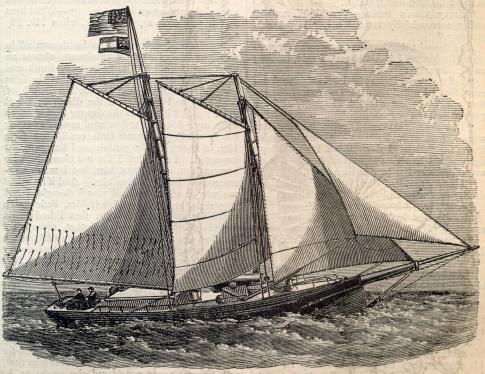
  • CSS Savannah flying both US and CS flags
  • The privateer Savannah, which left port in Charleston, South Carolina, only yesterday, overhauls the brig Joseph and sends her into Georgetown, SC. In the afternoon the brig U.S.S. Perry attacks and captures the privateer Savannah. Her cruise is ended and her crew is arrested and taken to New York./1861 
  • Confederate Secretary of War Stephen F. Mallory instructs Lieutenant John Mercer Brooke to develop an ironclad design for construction in the South./1861
  • Against its will but forced by Governor Henry M. Rector, the Arkansas Secession Convention finally adjourns, but political turmoil will continue in Confederate Arkansas. General William J. Hardee will be assigned to command Confederate forces in Arkansas, but many soldiers will not want to join the regular army and risk being moved away from their home state. A lack of organization and cohesive command will plague Arkansas for the remainder of 1861./1861

Wednesday, June 1, 2011

Recruits flood armies; Skirmishes at Arlington, Fairfax, VA

  • Confederate Mail Service begins as Confederate and US postal services end official cooperation , though mail will continue across the lines throughout the war in various ways./1861 
  • In northern Virginia, a small body of raw Confederate recruits routs and disperses 85 Regulars of the Second United States Cavalry at Chantilly, Virginia. The 2nd US Cavalry had been sent from Arlington to reconnoiter and engages the Confederate troops at Arlington Mills and Fairfax Court House. Virginia Militia Captain John Q. Marr, an officer of promise, of the Warrenton (VA) Rifles is killed. He is one of the first Southern officers to die for independence. The Yankees suffer several dead and wounded, and leave seven dead horses and many arms in the street./1861 
  • In a decision aimed at both United States and Confederate States vessels, the British government declares British territorial waters and ports off-limit to belligerents  vessels carrying spoils of war./1861
  • In Virginia, Southern boys are gathering into training camps and issued obsolete Mexican War flintlocks as frantic orders are placed in Europe for the new cap lock muskets./1861
  • At Cairo, Illinois, where the Mississippi and Ohio Rivers join, gun emplacements are being tested including a 32-lb. mortar./1861
  • The Sons of Erin, citizens of Ireland living in Donaldsonville, Louisiana, volunteer for Confederate service./1861

Tuesday, May 31, 2011

Beauregard to command Alexandria Line

    P.G.T. Beauregard. Mid 19th century photo in m...Image via Wikipedia
    Beauregard
  • P. G. T. Beauregard is ordered to assume command of the Confederate Army of the Potomac in northern Virginia at the Alexandria Line where Federal troops have invaded Virginia and taken up positions. In a strategy meeting with President Davis and commander of the Virginia Militia Robert E. Lee, Lee explains that the Federals are now occupying Alexandria and their next obvious move will be against Manassas, an important railroad junction for the Confederate forces./1861
  • Union troops which have evacuated forts in Indian territory a month ago arrive at Fort Leavenworth, Kansas today. The path they traveled will come to be known as the Chisholm Trail after one of their guides, Jesse Chisholm./1861
  • US Brig. Gen. Nathaniel Lyon and local politico Francis Blair take effective control of St. Louis, Missouri, from Brig. Gen. William Harney, whom they suspected of Southern sympathies and thus sacked with the quiet permission of President Lincoln./1861
  • In Washington, Robert Lincoln, John Hay, assistant secretary to President, and John G. Nicolay, private secretary to President, obtain passes to cross Long Bridge and visit the Custis mansion, home of Gen. Robert E. Lee (CSA), in Arlington./1861
  • The New Orleans Mint closes./1861

Thursday, May 26, 2011

McClellan invades western Virginia; Mobile, New Orleans blockaded

George B. McClellan. Library of Congress descr...Image via Wikipedia
G.B. McClellan
  • US Major General George B. McClellan crosses the Ohio River with Ohio State troops to cover northwestern Virginia, ordering the 1st Virginia (US) Infantry under command of Colonel Benjamin F. Kelley to move on Grafton, western Virginia, to protect the B&O Railroad/1861 
  • Georgia Governor Joseph E. Brown receives a letter from Virginia Militia Major General Robert E. Lee, noting that many Georgia volunteer companies arriving in Virginia did not have weapons. Lee requests Brown to please send any firearms or other equipment with Georgia recruits coming north to defend the South./1861
  • Lincoln’s Postmaster General, Montgomery Blair announces the halt of all postal connections with the Confederate States as of May 31, but mail communication across the lines would continue throughout the war under flag of truce./1861
  • The US naval blockade is emplaced at Mobile, Alabama, and New Orleans, Louisiana. The United States sloop of war Brooklyn, lately involved with the relief of Fort Pickens, at Pensacola, Florida, directs the blockade at New Orleans./1861

Saturday, May 14, 2011

Calls for "New Virginia", Jackson seizes train

John S. Carlile. John S. Carlile, a leader dur...Image via Wikipedia
John S. Carlile
West Virginia Independence Hall, site of the W...Image via Wikipedia
Site of the Wheeling Convention
  • At the First Wheeling Convention of Unionist Virginians seeking to form their own state in Wheeling, western Virginia, a heated debate arises between the two major factions of the Convention. One wants immediate separation from Virginia while the other advocates a structured separation. John S. Carlile of Harrison County insists that the convention has the authority to take action on separation. Delegates form a Committee on Credentials and a Committee on State and Federal Relations. Calling for a state of “New Virginia,” Carlile argues that Virginia must consent to the separation before it secedes from the Union. He feels that this is the only way to comply with Section Three of Article Four of the U.S. Constitution outlining the procedure by which one state is created from another. The Committee on State and Federal Relations recommends that a new state not be formed at this time and advises waiting for the results of the May 23 referendum. By this time, the Virginia Secession Convention has voted to secede, but still to come on May 23 is the referendum in which the people of Virginia will vote to ratify the Virginia Ordinance of Secession./1861 
  • At the mouth of the Potomac River, the Aquia Creek Battery is spotted by the blockading ship, USS Mount Vernon, but the vessel does not fire on the Virginia Militia who are in the process of adding a second battery aback the bluffs south of the confluence of the Aquia Creek with the Potomac River./1861
  • US Maj. Gen. Benjamin F. Butler seizes a vessel at Baltimore, Maryland, loaded with arms for the Confederate States and a large number of guns. Butler imprisons Ross Winans, of Baltimore, at Fort McHenry./1861
  • Major Robert Anderson receives word from President Lincoln that despite Kentucky’s neutrality, the Federal government will violate it to provide aid to Kentucky Unionists./1861
  • William Tecumseh Sherman reenlists in the US Army and is commissioned commander of the 13th Regular Infantry because of the influence of Ohio Senator John Sherman. After graduating from West Point, Sherman had left the Army for better pay to head the Louisiana State Seminary of Learning and Military Institute at Pineville (later Louisiana State University). He resigned in January 1861 to avoid surrendering the Federal Arsenal at Baton Rouge./1861
  • US Commander of the Department of Ohio, George B. McClellan, is promoted to major general in the US Army, his same rank in the Ohio militia. Only General-in-Chief Winfield Scott holds a higher rank./1861
  • Colonel Thomas J. Jackson directs the seizure of a train at Harpers Ferry, western Virginia. Meanwhile, Colonel George Porterfield arrives in Grafton, western Virginia to recruit and take charge of Confederate troops. After not finding any Confederates in this pro-Union town he goes to Fetterman, western Virginia, and finds Captain W. P. Thompson with his Company of Marion Guards./1861

Monday, May 9, 2011

Covert Confederate munitions arrive at St. Louis

St. Louis, Missouri in 1859
  • At St. Louis, Missouri, Missouri Volunteer Militia officers meet a shipment of crates on board the steamer J.C. Swon at the St. Louis riverfront marked Tamoroa marble, and transport them to Camp Jackson, six miles inland. In mid-April, Governor Claiborne Jackson had sent two militia officers, Colton Green and Basil Duke, to President Jefferson Davis in Montgomery, Alabama, requesting artillery and mortars for an attack on the St. Louis Arsenal. The crates of Tamoroa marble shipped to the Missouri Volunteer Militia are in fact two 12 pound Howitzers, two 32 pound siege guns, five hundred muskets, and ammunition from assets seized from the Federal arsenal at Baton Rouge./1861
  • At Newport, Rhode Island, the USS Constitution and the steamer Baltic (which had been the main ship in the Fox Expedition to Fort Sumter), prepare to set up the U.S. Naval Academy which has been moved from Annapolis, Maryland, because of uncertainties there./1861 
  • While many on both sides have expected a short war and have called for volunteers for mere months, President Jefferson Davis today wisely and quietly signs a measure setting all future enlistments “for the duration of the war” rather than a set period of time. In other work today in Montgomery, Alabama, Davis dispatches James D. Bullock to Great Britain to purchase arms and vessels from the British for the Confederate cause./1861
  • The Federal blockade of Virginia precipitates and exchange of gunfire between the Federal vessel Yankee and Confederate batteries on shore at Gloucester Point, Virginia./1861
  • Texas State Militia captures United States troops at San Lucas Spring, Texas./1861

Thursday, April 21, 2011

Upper South in turmoil

Professor Thomas J. Jackson, VMI
  • Pro-secessionist riots continue in Baltimore, Maryland as President Lincoln meets at the White House with Baltimore Mayor Brown and General Winfield Scott to find ways to stop the violence./1861
  • Colonel Thomas J. Jackson, professor at the Virginia Military Institute in Lexington, Virginia, attends chapel with the cadets this Sunday morning, then summons stagecoaches in the afternoon to the train station where he will lead nearly the entire school to travel to Richmond to enlist to defend Virginia, the Confederacy, and their homes./1861
  • In Wheeling, western Virginia, Monongahela County hosts Pro-Union delegates from the northwestern countries of Virginia in the Virginia Union Convention to pass resolutions against secession and elect a provisional government that in 1863 will become the new state of West Virginia. Senator Andrew Johnson, of Tennessee, is mobbed and treated rudely by a large crowd at Lynchburg, Virginia, as he passed through on his way from Washington to Tennessee. The Richmond Dispatch reported, “A large crowd assembled and groaned him, and offered every indignity he deserved, including pulling his nose.”  The conductor and others intervene, and Johnson is eventually able to continue on his way.”/1861 
  • Robert Breckinridge supported Abraham Lincoln ...Image via Wikipedia
    J.C. Breckenridge
  • Kentucky Senator John C. Breckinridge (and former US Vice President and future Confederate general and Confederate Secretary of War) rightly denounces Lincoln’s proclamation calling for troops as illegal and unconstitutional unless Congress approves a declaration of hostilities./1861
  • Louisiana Governor Moore asks the citizens of his state for 5,000 more infantry volunteers./1861
  • Colonel Earl Van Dorn assumes command of Confederate forces in Texas./1861
  • The Lincoln Administration, in a move to secure Washington, assumes government control of the Philadelphia and Baltimore Railroad. Manufacturers of Sharp’s rifles and Colt revolvers announce they will halt sales to the Southern states./1861
  • North Carolina militia seizes the United States mint at Charlotte, N. C./1861

Monday, April 11, 2011

Sumter's surrender demanded

Major Robert Anderson - Commander of Fort SumterImage via Wikipedia
Major Robert Anderson
Brig. Gen. P.G.T. Beauregard
  • [SIEGE OF FORT SUMTER] At 2 o’clock pm, Brigadier General Beauregard dispatches a party to demand the surrender of the United States garrison at Fort Sumter commanded by Major Robert Anderson. The party bearing the demand is composed of Confederate Colonel James Chestnut, former US Senator from South Carolina, Colonel A.R. Chisolm representing South Carolina Governor Francis Pickens, and Captain Stephen Dill Lee, formerly of the US Army. Around 4 o’clock in the afternoon, Aid-de-camp Captain Stephen D. Lee tenders the request for surrender personally from Beauregard to Anderson that Beauregard is “ordered by the Government of the Confederate States of America to demand the evacuation of Fort Sumter.” General Beauregard's liberal terms are as follows: "That Anderson evacuate the fort with his command taking small arms, private and company property, saluting the United States flag as it is lowered and being conveyed, if he desires it, to any Northern port." After consulting with his officers, Anderson formally answers that his sense of honor and his obligations to his government prevent his compliance. Anderson also casually remarks that the garrison would "be starved out in a few days." Upon his refusal, Beauregard telegraphs War Secretary Walker in Montgomery and communicates both the official answer and Anderson's informal verbal remarks. In the evening, Beauregard receives instructions from Secretary Walker to get a specific commitment from Anderson as to the time he would evacuate the fort, as well as an agreement that he would not use his guns against them unless under attack. Walker encourages Beauregard to wait and see if Anderson instead evacuates Sumter in order to “avoid the effusion of blood.” "If this or its equivalent be refused," Walker orders, "reduce the fort as your judgment decides to be most practicable." As they have done throughout the insulting siege of Fort Sumter, from the time Anderson ran in the night from Fort Moultrie and turned guns on the citizens of Charleston after Christmas, the Confederate government, eager to pursue a peaceful separation, has maintained its restraint and continues to hold its fire while the Lincoln Administration do nothing to escalate the crisis./1861 
  • The three Confederate Peace Commissioners, Crawford, Forsyth, and Roman, sent weeks ago to the US Government to forge peaceful relations with the new Lincoln Administration, leave today for the Confederate capital of Montgomery, Alabama. Despite the diplomatic efforts of US Secretary of State William Seward, they are arrogantly rebuffed, ignored, and unrecognized by the new war-mongering President eager to take his stand, enforce his will, and retain the large federal tax revenues of the seceded South./1861
  • An 1861 engraving of Fort Sumter before the at...Image via Wikipedia
    Fort Sumter
  • The First Louisiana Regulars depart New Orleans and head to Pensacola, Florida./1861
  • Adjutant and inspector general of the Confederate army Sam Cooper communicates an order to Colonel Earl Van Dorn, to go to Texas to take charge of Confederate forces there. His main responsibility will be to make sure that U.S. troops are not allowed to leave the state. Those willing to enter Confederate service should be accepted, those not willing are to be treated as prisoners of war./1861

Monday, March 21, 2011

Fox in Charleston

  • Gustavus V. Fox, on orders from President Lincoln to assess the situation at Fort Sumter and the mood of the Southern leaders, arrives in Charleston, South Carolina. He meets with South Carolina Governor Francis W. Pickens and Confederate Brigadier General P. Gustave T. Beauregard, and after some delay, is given permission to visit Fort Sumter. He reached the fort that evening, "after dark and remained about two hours," discussing the situation with Major Anderson. He hints at, but does not explicitly describe to Anderson, his plan to reinforce the fort./1861
  • The Missouri Secession Convention adjourns after having voted 89-1 against secession/1861
  • The State Convention of Louisiana ratifies the Confederate States Constitution/1861
  • Confederate Vice-President Alexander Stephens delivers to Georgia's secession convention in Savannah his infamous Cornerstone Speech - claiming that slavery was the foundation of Southern society: ...“The new constitution has put at rest, forever, all the agitating questions relating to our peculiar institution -- African slavery as it exists amongst us -- the proper status of the negro in our form of civilization. ...Our new government is founded upon, . . . its foundations are laid, its corner-stone rests upon the great truth, that the negro is not equal to the white man; that slavery -- subordination to the superior race -- is his natural and normal condition. [Applause.]” His now unacceptable speech, while revealing the sinfulness and fears of loss of the elite planter class, did not have a bearing on the vast majority of white Southerners who were too poor to own even one slave. Those men fought to protect their homes from an invader, and the slavery argument was superfluous to them./1861

Saturday, February 26, 2011

Davis calls for US release of Sumter, Pickens

President Davis
  • President Jefferson Davis nominates W. L. Yancey of Alabama, P. A. Rost of Louisiana, and A. Dudley Mann of the Confederate States as members of a European Commission to promote the interests of the Confederate States of America overseas./1861
  • President Davis also writes the US Congress calling on it to release all armaments rightfully belonging to Southern states (including Forts Sumter and Pickens), arguing that they now should transfer to the Confederacy./1861
  • In Washington, President-elect Lincoln holds an interview for several hours with Gov. Thomas H. Hicks (Md.), Sen. Douglas (Ill.), and others who recommend that he use his influence for the settlement of pending difficulties./1861

Friday, February 25, 2011

US warship lurks as peace commissioners sent to Lincoln


Confederate Senate in Alabama Senate chamber
  • President Davis and president of the Montgomery Convention, Howell Cobb, advise the US Congress that they are sending three commissioners from the Confederacy to the United States, A. B. Roman, of Louisiana; Martin J. Crawford, of Georgia; John Forsyth, of Alabama, to Washington to discuss peace terms with President-elect Lincoln. In other business, Confederate Congress declares that the Mississippi River is freely opened to navigation by all states of the Confederacy/1861
  • Governor Pickens of South Carolina telegraphs President Davis that a war steamer of the United States is lying off Charleston Bar laden with reinforcements for Fort Sumter and that he would like advice as to what to do. President Davis replies that Governor Pickens should use his own discretion/1861 
  • In Washington, President-elect Abraham Lincoln, escorted by former New York Senator and Secretary of State-designate William Seward, attends an informal reception in both houses of Congress and visits justices of the Supreme Court during the afternoon. Meanwhile, US Supreme Court Justice from Alabama, Hon. John Archibald Campbell, acting as mediator, tells the Peace Commissioners meeting in Washington's prestigious Willard Hotel that according to Seward, the new Administration will evacuate Fort Sumter at Charleston, South Carolina, and not reinforce Fort Pickens at Pensacola, Florida, yet nothing will change./1861
Old Alabama Senate Chamber

    Saturday, February 19, 2011

    Davis makes Cabinet appointments

    Confederate Cabinet
    • Jefferson Davis begins to form a Cabinet in Montgomery. Robert Toombs will become Secretary of State. Leroy P. Walker will be Secretary of War. Christopher G. Memminger will head Treasury. Judah P. Benjamin will be Attorney General, the first Jewish Cabinet member in the history of North America. Stephen Mallory will be Secretary of the Navy, and John Reagan will become Postmaster General, a position he will hold throughout the life of the Confederacy./1861

    Lincoln at Astor House, NYC
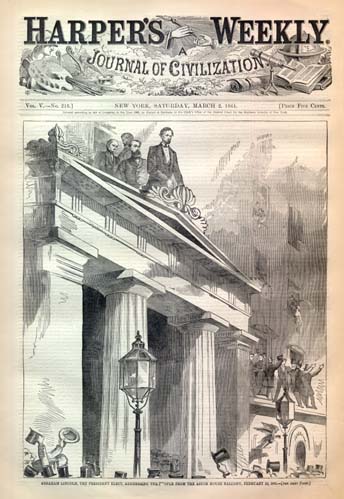
    • President-elect Abraham Lincoln, using his trip to his inauguration to an advantage, is greeted by an estimated 250,000 well-wishers in New York City. According to the Morning Courier and New York Enquirer, Lincoln was greeted by “thunders of applause . . . deafening cheers, waving of handkerchiefs.” Frank Leslie’s Illustrated Newspaper, however, stated that while the crowd showed “much respect” there was “little enthusiasm.”/1861

    • Louisiana state militia takes control of the US paymaster’s office in New Orleans./1861

    Saturday, February 12, 2011

    Lincoln goes on damage control


    • On his trip to Washington, President-elect Lincoln makes numerous stops along the way, but in an effort to tone down his remarks yesterday in Indianapolis about the preservation of the Union which angered Upper South and other conservative Democrats, he goes out of his way to avoid expressing his real opinions, asking citizens in Cincinnati to be loyal to the Constitution, and even stating to several thousand of the German Industrial Association in Cincinnati that he will not reveal what he plans to do with the national crisis as President. "I deem it my duty that I should wait until the last moment, for a development of the present national difficulties, before I express myself decidedly what course I shall pursue.”/1861
    • Jefferson Davis, President-elect of the Confederacy, also makes whistle stops on his way to Montgomery, Alabama, at one stop admitting that secession could eventuate in war./1861
    • The Arkansas State Militia seizes the US Arsenal at Napoleon, Arkansas/1861
    • Louisiana adopts its own state flag. Louisiana's Governor Thomas O. Moore obtains control of Federal property in the State with the help of the Legislature./1861
     

    Tuesday, February 8, 2011

    Confederate Constitution adopted

    Old Alabama Senate Chamber
    • Delegates to the Convention in Montgomery adopt a provisional Constitution, and a provisional Confederacy officially comes into existence. With several significant changes, including a six-year term for President, the right to own slaves, the outlawing of the slave trade, the right of a free state to join the Confederacy, an appeal to Almighty God in the preamble, and the sovereign power of the states, the document closely resembles the United States Constitution. /1861
    • Fulfilling orders from Georgia Governor Joseph E. Brown, state military authorities in Savannah seize five ships loaded with goods bound for New York. The seizure is in response to New York police seizing 200 guns purchased by a Macon firm for shipment to Georgia. Governor Brown had contacted the governor of New York to have the guns released, but Governor Edwin Morgan failed to respond. So finally Governor Brown ordered that Georgia military forces seize every ship at the port of Savannah belonging to citizens of New York./1861
    • The Confederacy receives a $500,000 loan from Louisiana. The money came from the New Orleans mint and the United States Customs office, lately seized by the Louisiana Militia./1861 

    Friday, February 4, 2011

    States convene in Montgomery


    Montgomery, Alabama
    • Representatives from the seceded states, Georgia, Florida, Alabama, Louisiana, Mississippi, and South Carolina, open a convention in Montgomery, Alabama. It is the initial meeting of what will become the Provisional Congress of the Confederate States of America. Howell Cobb of Georgia is elected president of the convention. The meeting is attended by many former United States senators, including Louisiana’s Judah P. Benjamin and John Slidell, law partners in New Orleans. Benjamin will become Attorney General, then Secretary of War, then Secretary of State, the first Jewish Cabinet member in North American history. Slidell will become involved in the famous international incident, the Trent affair./1861 
    • Virginians vote for delegates to a state convention to discuss Secession/1861 
    • In Washington, the Peace Convention, opens with 131 delegates from 21 states led by Virginia, with the seceded states conspicuously missing. The Convention is headed by former President John Tyler, who has joined with like-minded people in a last desperate effort to compromise and save the Union./1861