Showing posts with label Missouri. Show all posts

Tuesday, August 30, 2011

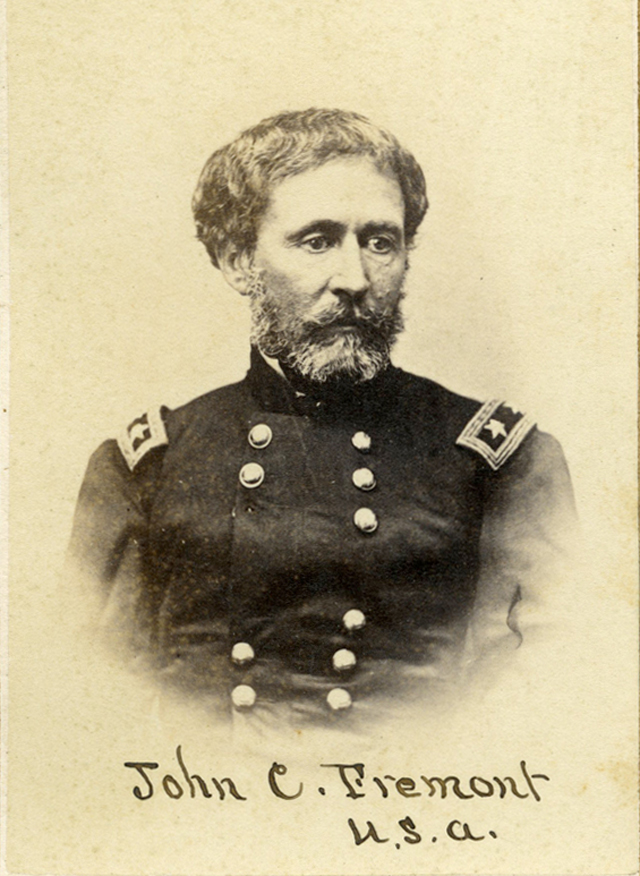
Fremont declares martial law, confiscations in Missouri

  • General John Fremont declares a dictatorial martial law across the state of Missouri. The unauthorized act provides for confiscation of all property belonging to "those who shall take up arms against the United States," with his intention to shoot any of them who are convicted by military court-martial. Fremont also declares that "slaves . . . are hereby declared free men." In defense of this unpopular move, Fremont says Missouri is a victim of "helplessness of civil authority and total insecurity of life." This Missouri Emancipation Proclamation is later revoked by President Lincoln. /1861
  • The Confederate tug Harmony attacks the USS Savannah under Captain Joseph B. Hull at Newport News, Virginia, inflicting damage before withdrawing./1861
  • Skirmishing continues at Bailey's Corners, Virginia./1861

Tuesday, August 23, 2011

Rose O'Neal Greenhow placed under house arrest

GreenhowImage via Wikipedia
Rose O'Neal Greenhow
  • In Washington, D.C., Allen Pinkerton, leading the new US secret service, places Confederate spy Rose O'Neal Greenhow under house arrest. A wealthy Washington widow at the outbreak of the war, Greenhow is well connected in the capital and especially close to Senator Henry Wilson of Massachusetts. Openly committed to the Southern cause, Greenhow has formed a reliable spy network for the Confederacy. Her operatives had provided key information to General Pierre G. T. Beauregard about Union General Irwin McDowell's troop deployments before First Manassas in July, prompting Beauregard to request additional troops and win a decisive victory. The Federals quickly tracked down the leaks in Washington, and Pinkerton today places Greenhow under house arrest and will soon confine other suspected women in her home. But Greenhow would be undeterred in funneling information to the Confederates from visitors, including Senator Wilson. In frustration Pinkerton in early 1862 would confine Greenhow and her daughter to the Old Capitol Prison for five months, later exiling her and her daughter, "Little Rose," to the South in June 1862. Greenhow would later travel to England and France encouraging support for the Southern cause, writing her memoirs while abroad. Returning to the Confederacy in September 1864, Greenhow’s ship would run aground off the North Carolina coast as a Union war vessel chased it. Greenhow would drown when her lifeboat capsized, weighed down by a large load of gold./1861
  • The USS Release and Yankee engage Confederate batteries at the mouth of Potomac Creek, Virginia./1861
  • Skirmish occurs at Medoc, Missouri./1861
  • Fort Craig, New Mexico Territory, is abandoned by Federal forces after a skirmish./1861
  • Forces skirmish at Springfield, Western Virginia./1861

Monday, August 22, 2011

Confederate Army of New Mexico on march

USS LexingtonImage via Wikipedia
USS Lexington

Saturday, August 20, 2011

State of Kanawha proposed; New CS diplomats approved

  • The pro-Union Second Wheeling Convention, the group of thirty-nine western Virginia counties which have seceded from the Commonwealth of Virginia, calls for the creation of the state of Kanawha. /1861
  • President Jefferson Davis approves the addition of Confederate commissioners to Europe. Everyone hopes that an eloquent commissioner like Benjamin Franklin can acquire needed arms, supplies, and recognition from Great Britain, France, and Spain/1861
  • Pro-Southern and Pro-Northern forces in Missouri battle it out at Jonesboro which follows a similar clash several days earlier at Klapsford. /1861
  • US Major-General George B. McClellan assumes command of the newly organized Department of the Potomac, replacing the Departments of Northeastern Virginia, Washington, and the Shenandoah./1861

Friday, August 19, 2011

Confederate alliance with Missouri; More newspapers seized

Confederate bond
  • In Charleston, Missouri, the Battle of Charleston (Bird's Point) is a minor clash in which Union forces led by Col. Henry Dougherty destroy a Confederate camp. This skirmish is the culmination of several skirmishes in the Charleston and Bird's Point area for the past week between pro-Union forces and secession groups./1861
  • Newspaper offices in Easton and West Chester, Pennsylvania, are seized by the Lincoln Administration for their supposed Southern sympathies. The editor of the Essex County Democrat in Haverhill, Massachusetts, is tarred and feathered for his pro-Confederate feelings/1861 
  • Trying to settle the political and military chaos in Missouri, the Confederate Congress in Richmond, Virginia, agrees to an alliance with Missouri's secessionist government The Congress also passes an Act authorizing the sale of Confederate Bonds. /1861 
  • US Assistant Secretary of the Navy Gustavus V. Fox orders 200 US Marines to report to Commander Dahlgren at the Washington Navy Yard for duty on board ships of the Potomac Flotilla for the purpose of scouting the Maryland countryside—especially Port Tobacco—for locations suspected of being Confederate depots for provisions and arms to be used for invading Maryland./1861
  • In Washington, Henry Halleck is promoted to Major General./1861

Wednesday, August 17, 2011

US Army changes & NC Stone Fleet ready

  • In Washington, President Lincoln orders a commission for Kentuckian Simon Bolivar Buckner as brigadier general of volunteers (which he will refuse in preference for a Confederate general’s commission),  and George Thomas of Virginia is appointed US brigadier general of volunteers, Army of the Cumberland. US General Wool takes command at Fortress Monroe, Virginia, superseding Benjamin Butler. In a reorganization, the US Departments of Northeastern Virginia, Washington (DC), and the Shenandoah are merged into the US Department of the Potomac, officially forming the Union Army of the Potomac, which would commit most of the bloodshed in the Eastern Theater of the war. Maj. Gen. Henry “Old Brains” Halleck is made commander of the new Department of the Potomac. Today also Lincoln watches another exhibition of J. D. Mills' gun, dubbed by Lincoln "coffee mill gun,” near the Washington Monument and advises the government to pay double the sum that mechanics say it is worth if delivered in 30 days. /1861
  • North Carolina coast
    US Lieutenant Reigart B. Lowry writes US Assistant Secretary of the Navy Gustavus V. Fox regarding the progress for sinking a stone fleet to block the inlets to the North Carolina sounds: "We have nineteen schooners properly loaded with stone, and all our preparations are complete to divide them in two divisions and place them in tow of this steamer [Adelaide] and of the Governor Peabody. I think all arrangements are complete, as far as being prepared to 'sink and obstruct' . . . the obstructing party could place their vessels in position, secure them as we propose, by binding chains, spars on end in the sand to settle by action of the tide, anchors down, and finally sink them in such a way as to block the channel so effectually that there could be no navigation through them for several months to come, at least till by the aid of our new gunboats the outside blockade could be effectual."/1861
  • Skirmish at Brunswick, Missouri./1861

Tuesday, August 16, 2011

Lincoln moves to curb freedom of New York press

Abraham Lincoln, the sixteenth President of th...Image via Wikipedia
President Lincoln
  • In Washington, President Abraham Lincoln issues a proclamation declaring the seceding States in a state of insurrection and prohibiting all trade and public intercourse with them. This proclamation is important as a legal issue. First, it serves notice that no further compromising will be done with the seceded states. In addition it ends a thriving cotton trade in the border states. Most importantly, it makes lawful any action that the Administration would like to take against anyone in the North whom it deems to be trafficking with the enemy. These actions could include curbing freedom of the press and jailing suspected individuals without charges for indefinite periods (suspension of the writ of habeas corpus, which is protected and guaranteed in the US Constitution). And the Lincoln Administration doesn’t waste any time. In New York, the Lincoln Administration indicts several New York newspapers in court for alleged pro- Confederate leanings, among them are the New York Journal of Commerce, the Brooklyn Eagle, and the New York Daily News/1861 
  • Patriot and Union forces clash at Fredericktown and Kirkville, Missouri/1861 

Monday, August 15, 2011

The West: Reconnaissance, reinforcements, and reconfigurations

USS TylerImage via Wikipedia
USS Tyler
  • On the Mississippi River in Missouri, the USS Tyler and Conestoga under Lieutenant S.L. Phelps scouts the river for Confederate fortifications and movements as far south as New Madrid, Missouri, while Lieutenant Roger N. Stembel of the USS Lexington, operating with the US Army, reconnoiters the river north to Cape Girardeau, Missouri./1861
  • At Mathias Point, Virginia, the USS Resolute, under command of Acting Master W. Budd, engages Confederate troops in land batteries while on a reconnaissance mission./1861
  • The US Department of Kentucky and the Department of the Cumberland are combined under General Robert Anderson, the Union’s tragic hero of Fort Sumter. The new Department of the Cumberland encompasses both Kentucky and Tennessee, violating Kentucky’s neutrality and laying claim to another state which has allied with the Confederacy. Anderson’s department headquarters situated in Cincinnati, Ohio, demonstrates its geographical fiction and Lincoln's invasive intentions./1861
  • In Washington, while President Lincoln directs new reinforcements be sent to subdue Missouri and forcibly hold her in the Union, he anxiously works on the volatile situation in Missouri by telegraph. He telegraphs Gen. John Fremont, commanding the Department of the West at Saint Louis: "Been answering your messages ever since day before yesterday. Do you receive the answers? The War Department has notified all the governors you designate to forward all available force. So telegraphed you. Have you received these messages? Answer immediately." Then he telegraphs Governor Morton of Indiana: "Start your four regiments to Saint Louis at the earliest moment possible. . . . hasten everything forward as soon as any one regiment is ready. . . . We shall endeavor to send you the arms this week."/1861

Sunday, August 14, 2011

Martial law declared in St. Louis

John C. Frémont. Library of Congress descripti...Image via Wikipedia
The odd bird John Fremont
  • US General John Fremont declares martial law in St. Louis, Missouri. Fremont also orders two newspapers closed for allegedly pro-Southern editorials./1861
  • In Richmond, Jefferson Davis orders the banishment of all foreign nationals whose home countries did not recognize the Confederate government./1861
  • In Washington, President Lincoln decides to violate further Kentucky’s neutrality and Tennessee’s sovereignty and send assistance to Union men in Kentucky and Tennessee. He selects Brig. Gen. Robert Anderson, a Kentuckian, to command three brigades, and consults again with Tennessee Senator Andrew Johnson and Congressman Maynard. /1861

Friday, August 12, 2011

McCulloch: "Let Missouri choose her destiny"

photo of Benjamin McCulluch (1811-1862)Image via Wikipedia
Gen. Ben McCulloch
  • After Federal forces under Gen. Nathaniel Lyon have chased the pro-secession Missouri State Guard, its commander, Gen. Sterling Price, and its duly elected Governor Claiborne Fox Jackson, out of the state capital at Jefferson City and nearly out of the state. At last, at Wilson’s Creek near Springfield, reinforced by Confederate General Benjamin McCulloch’s Western Army composed of Arkansans and Cherokees, they had made a stand, and now Lyon is dead and the Federals in retreat. Gen. Ben McCulloch, today gives Missouri citizens an ultimatum: it is time to take sides. Unlike Lyon and the Federals, McCulloch promises protection to Union sympathizers, but “Missouri must be allowed to choose her own destiny.”/1861
  • At Washington, by proclamation, President Lincoln appoints the "last Thursday in September next, as a day of humiliation, prayer and fasting for all the people of the nation." In a recess appointment, Lincoln reappoints William S. Wood, who had charge of the special train that brought Lincoln to Washington for his inauguration, as commissioner of public buildings, as the Senate failed to act on his appointment before adjourning. /1861
  • US Navy Commander J. Rodgers arrives with gunboats USS Tyler, Lexington, and Conestoga, at Cairo, Illinois, to protect the junction of the Ohio and Mississippi Rivers and to guard against Confederate movements./1861

Wednesday, August 10, 2011

Battle of Wilsons Creek, Missouri; Lyon killed

Battle of Wilson's Creek--Aug. 10, 1861--Union...Image via Wikipedia
Battle of Wilson's Creek, Missouri

Monday, August 8, 2011

Davis calls for 400,000 volunteers to defend the South


    Jefferson Davis, only President of the Confede...Image via Wikipedia
  • In Richmond, President Jefferson Davis calls for 400,000 volunteers to defend their homes in the Confederacy./1861
  • At Washington, US Secretary of War Simon Cameron replies to another of General Benjamin Butler’s queries about making runaway slaves contraband. Cameron tells Butler that Union troops must adhere to fugitive slave laws, but only within Union territory. All states in insurrection are exempt from the protection and escaped slaves in those areas will not be returned to their owners but become property of the US government./1861
  • In the Gulf of Mexico, the USS Santee, commanded by Captain Eagle, captures the blockade runner schooner C.P. Knapp./1861
  • Brig. Gen. U. S. Grant assumes command of the district of Ironton, Missouri./1861
  • At a public dinner and serenade in Baltimore, Maryland, in honor of John C. Breckenridge of Kentucky, his attempt to address the people is prevented by the rioting of Unionists./1861

Friday, August 5, 2011

Unionists win battle of Athens, Missouri

  • In Missouri, US General Nathaniel Lyon pulls out of Dug Springs as he receives reports that Confederate troops are advancing in large numbers.  A skirmish occurs at Kirksville, Missouri, and small battle at Athens (pronounce Aythens), Missouri. The Battle of Athens occurs in northeast Missouri near southeast Iowa along the Des Moines River across from Croton, Iowa. Colonel Martin Green's force of about 2,000 secessionist 2nd Division Missouri State Guardsmen with three cannons tries to capture Athens from about 500 Unionist 1st Northeast Missouri Home Guard commanded by Col. David Moore. Moore calls out his regiment at 5am when pickets warn of the secessionists' advance. With many men home visiting family without orders and after moving his sick over the river to Iowa, Moore is left with 333 men to fight 2,000. Green's much larger force surrounds Athens on three sides, with the river to the Unionists’ backs. Lieut. Col. Charles S. Callihan commanding the Union left flank faces Major Shacklett's cavalry and James Kniesley's three gun battery. The Unionists have no artillery, but Kniesley's guns are not much better, only a 6-pounder, a 9-pounder, and a hollowed log, a few solid shot and improvised canister. They have no impact in the battle except to spook a cavalry scout’s horse. The first cannon shot flies over the Unionists and the Des Moines River into the Croton, Iowa, rail depot. The second shoots through the Benning home and into the river. The log cannon blows apart on the first firing. The 2,000 poorly equipped, untrained, and untested secessionist State Guardsmen advance, generally firing their shotguns and squirrel rifles, while Moore’s 333 men are much better armed with Springfield rifled muskets and bayonets. Captain Hackney's Home Guard drives the State Guard away from Stallion Branch while US Lt. Col. Callihan’s men flee for the river with one of the Home Guards cavalry units at the sight of Major Shacklett's large force advancing. The others hold their positions, and the advance falters in a cornfield. After Shacklett is wounded in the neck, his men fall back. Seeing this, Moore fixes bayonets and countercharges, sending the State Guardsmen into a headlong retreat including Kniesley’s artillery. The Iowa militia watches from across the river and fire a few shots from long range with no effect. The Unionist Home Guardsmen win. Moore has three dead and twenty wounded. Missouri State Guard losses are unknown, but Moore captures twenty men, most of them wounded. Moore estimates 31 Missouri State Guard killed and wounded, and captures 450 horses with bridles and saddles, hundreds of arms, and a wagon load of long knives. The defeat demoralizes secessionist state guard efforts in Northeast Missouri. The Union victory has the distinction of being the most northerly of Civil War Battles fought west of the Mississippi, and also of being the only such battle fought along the Iowa border./1861
  • The USS Vincennes/Jamestown under Commander Charles Green captures and burns the Confederate prize bark Alvarado, a blockade runner, off the coast of Fernandina, Florida./1861
  • Off the coast of Puerto Rico, the Confederate privateer Jefferson Davis captures the large American brig Santa Clara./1861
  • In Washington, President Lincoln approves a Congressional resolution to observe a day of public humiliation, fasting, and prayer and also approves the new income tax of 3 per cent on income exceeding $800 per year and other taxes./1861

Thursday, August 4, 2011

Freeborn captures prizes; battle looms in NE Missouri

Sighting a gun aboard Thomas Freeborn, 1861Image via Wikipedia
Sighting a gun on USS Freeborn

  • In Pohick Creek, Virginia, the USS Thomas Freeborn under Lieutenant Eastman, captures the schooner Pocahontas loaded with wood, and the sloop Mary Frey./1861
  • In northeast Missouri, Colonel Martin E. Green, commanding the 2nd Division of the secessionist Missouri State Guard (about 2000 men and 3 cannons), bivouacs seven miles west of Athens (pronounced Aythens), Missouri, in preparation for a retaliatory attack on the 1st Northeast Missouri Home Guard (333-500 men) under Col. David Moore for the Union destruction of Green’s training camp on July 21st. While Moore attempts to prepare for the attack, several of his company commanders without orders allow their men to visit their homes. In a panic, Moore calls for reinforcement from the Iowa State Militia companies in Croton and Keokuk, Iowa, but they would not cross the river in time to participate in the engagement on August 5th. /1861

Wednesday, August 3, 2011

US Congress invests in ironclad technology as blockade tightens

  • In Washington, the US Congress authorizes Secretary of the Navy Gideon Welles to appoint a three-member board to plan and construct “iron or steel-clad steamships or steam batteries” and appropriates $1.5 million dollars for the purpose./1861
  • US General Nathaniel Lyon skirmishes with Missouri State Guard troops at McCulla's Store, Missouri/1861 
  • In Washington, Prince Napoleon (Napoleon Joseph Charles Paul Bonaparte) of France, the nephew of the former French emperor and traveling in U.S. as private citizen, visits President Lincoln at noon. The Prince, arriving at the White House with Baron Mercier, found no one—neither butler nor doorman—at the main entrance to show him in, and an employee who happened to be passing by, took care of this duty. The meeting was "not so gay"; the Prince, huffed at his reception, "took a cruel pleasure in remaining silent." At 7 p.m., President Lincoln and his wife, Mary, host a state dinner for Prince Napoleon. He is seated at the right of Mrs. Lincoln and opposite General Winfield Scott, who is at the President's left. Gen. George B. McClellan is at the right of the Prince. The dinner turns out to be an unusually sociable and enjoyable affair./1861
  • At Hampton Roads, Virginia, John LaMountain makes the first ascent in a balloon from Union ship Fanny to observe Confederate batteries on Sewell’s Point, Virginia—a harbinger of the twentieth century aircraft carrier./1861
  • Off the coast of Charleston, South Carolina, the USS Wabash, commanded by Captain Mercer, recaptures the American schooner Mary Alice, which had been taken by Confederate ship Dixie, and also captures the blockade running brig Sarah Starr. /1861  
  • At Galveston, Texas, the USS South Carolina under Commander Alden, engages Confederate batteries on the Galveston coast./1861

Tuesday, August 2, 2011

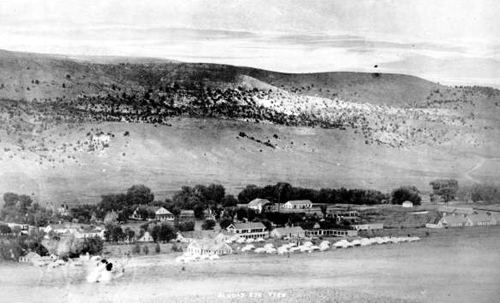
Fort Stanton, New Mexico, falls to Texans

Fort Stanton, New Mexico Territory
  • In a sweeping new grab of Federal power, the US Congress passes a bill establishing a national income tax and new tariffs to finance the war effort. The income tax is 3% and applies to those with incomes over $800 per year. These new taxes are projected to raise $500 million for the Union government, but because of its disfavor, the income tax is never actually put into effect./1861
  • In Missouri, US General Nathaniel Lyon clashes in a skirmish with pro-secessionists under General Ben McCulloch at Dug Springs. Anticipating further unrest in Missouri, US General John Fremont, stationed at St. Louis, sends General Lyon reinforcements./1861
  • In the US Territory of New Mexico, Federal troops evacuate Fort Stanton in the face of Lieutenant Colonel John Baylor’s West Texans of the 2nd Texas Mounted Rifles./1861

Sunday, July 31, 2011

Lincoln empowered to declare insurrection's existence

Lincoln
  • In Washington, the Lincoln Administration submits eleven Union officers’ names to Congress for promotion to brigadier general. Among them are William B. Franklin, Samuel Heintzelman, Joseph Hooker, William Tecumseh Sherman, and Ulysses S. Grant, stationed in Illinois, made a General of Volunteers. Many people North and South realize after the events of July that the war will be more than three months’ duration and now expect it to continue for a few months more./1861
  • In a breathtaking increase in tyrannical executive power, President Lincoln approves an act empowering the Chief Executive to decide when and where a state of insurrection exists./1861
  • In the new (unelected) pro-Union state government of Missouri, meeting at St. Louis, Hamilton Gamble is elected Governor by the legislature, replacing the duly elected pro-secession Governor Claiborne F. Jackson, who is in command of the Missouri State Guard in southwest Missouri, fighting the US government for Missouri’s right to state sovereignty but being pursued by US Brig. Gen. Nathaniel Lyon. Meanwhile in northeast Missouri, following a July 21st attack by Unionist 1st Northeast Missouri Home Guard Regiment commanded by Colonel David Moore at Etna, Missouri, on the secessionist training camp of the Missouri State Guard’s 2nd Division under Colonel Martin E. Green, today Colonel Moore responds by entering Edina in Knox County, Missouri, stampeding the local Home Guards with his 1st Cavalry Regiment, then proceeding toward his target, Col. Moore's Unionist regiment in Athens. Meanwhile, several hundred of Moore's regiment receive the new Springfield rifled muskets./1861
  • Aeronaut John LaMountain makes his first successful balloon flight from Fort Monroe observing Confederate defenses throughout the Hampton Roads area./1861